JHA, AHA & JSA Compliance Checklist: What Auditors Check
An incomplete or generic pre-task document is one of the most common findings in OSHA citations, USACE contract audits, and client pre-qualification reviews and most of the time, the gap is a missing field, not a missing effort. This checklist covers what a job hazard analysis (JHA), activity hazard analysis (AHA), and job safety analysis (JSA) each need to hold up under review, plus a quick-reference table for US, Australian, Canadian, UK, New Zealand, and UAE requirements. Use it before every submittal.
QuickJHA generates a formatted, regulation-mapped version of any of these three documents in under 30 seconds if you'd rather skip the manual build.
Quick Answer:
What a JSA Checklist Consists Of
A defensible JSA
consists of the same-day task and crew (not a standing generic form),
documented crew participation and sign-off, PPE itemized per step, safe work
practices referenced (lockout/tagout, hot work, confined space entry), site and
environmental conditions noted, and emergency response information. The full
breakdown for JHA, AHA, and JSA follows below each document type has its own
checklist because each serves a different purpose and audience.
Document 1: JHA Checklist
A job hazard
analysis is the general-purpose document most private-sector employers use. Use
this list before submitting or filing one:
•
Task
broken into sequential steps: each step of the job listed in the
order performed, not bundled into broad phases
•
Hazard
identified per step: every step names its specific hazard(s):
struck-by, caught-in/between, fall, electrical, chemical, ergonomic
•
Initial
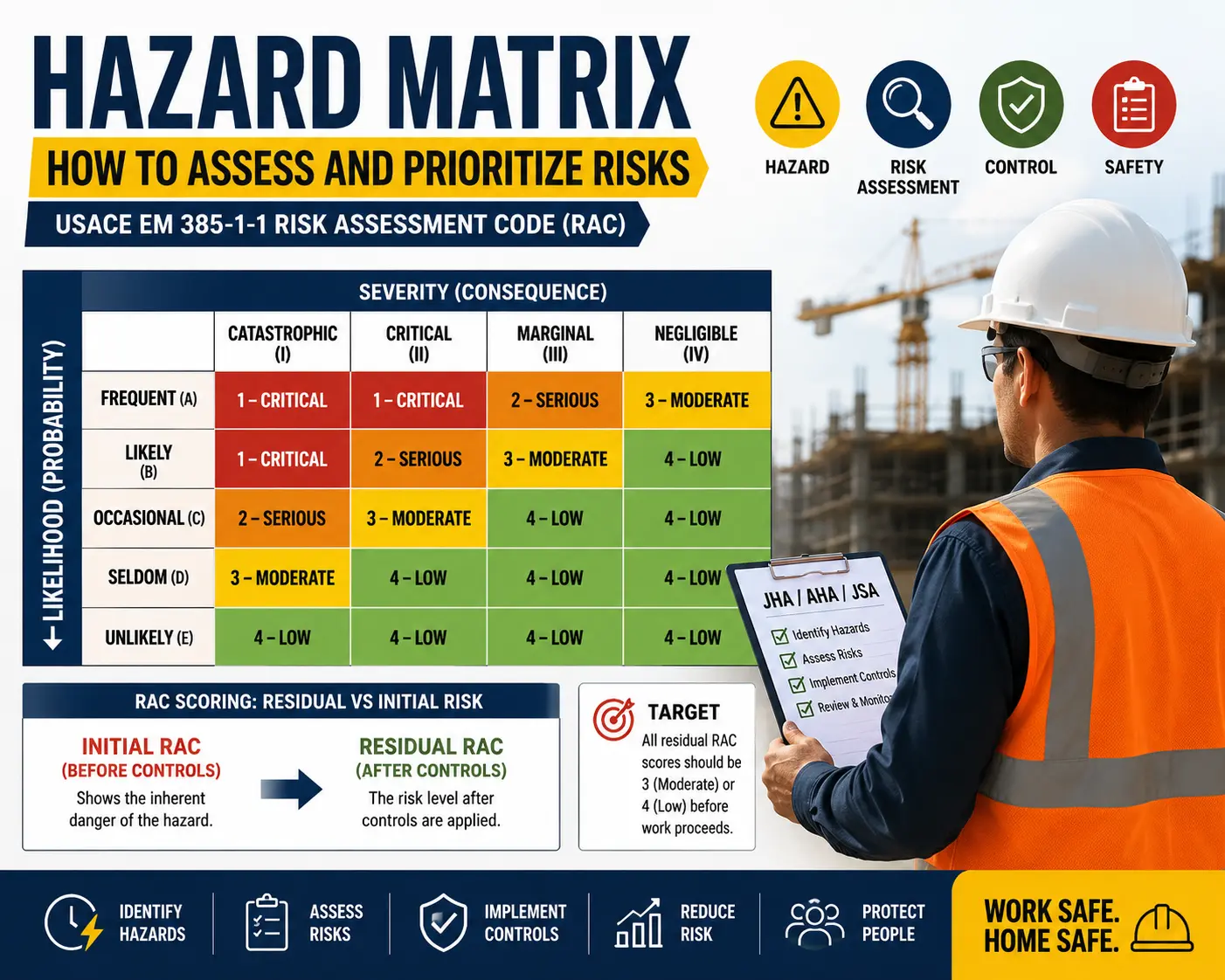
risk rating applied: severity × probability scored using a Risk
Assessment Code (RAC) or equivalent matrix, before controls
•
Control
measures documented: engineering, administrative, and PPE controls
listed per hazard, in that order, following the hierarchy of controls
•
Residual
risk re-scored: the risk level after controls are applied is shown,
not just the initial rating
•
Equipment
and tools listed: all tools, machinery, and competent-person
requirements named explicitly
•
Required
training and certifications noted: confined space entry, fall
protection, forklift operator, and similar
•
Applicable
standard cited: OSHA 29 CFR 1910/1926, Cal/OSHA, or the relevant
jurisdictional code, referenced by section
•
Site-specific,
not generic: project name, location, and date included; hazards
reflect actual site conditions
•
Signed
and dated: reviewed by a competent person or supervisor and
acknowledged by the crew before work starts
Common failure point:
JHAs written from a
template library without adjusting hazards to actual site conditions are the
number one reason documents fail prequalification or audit review.
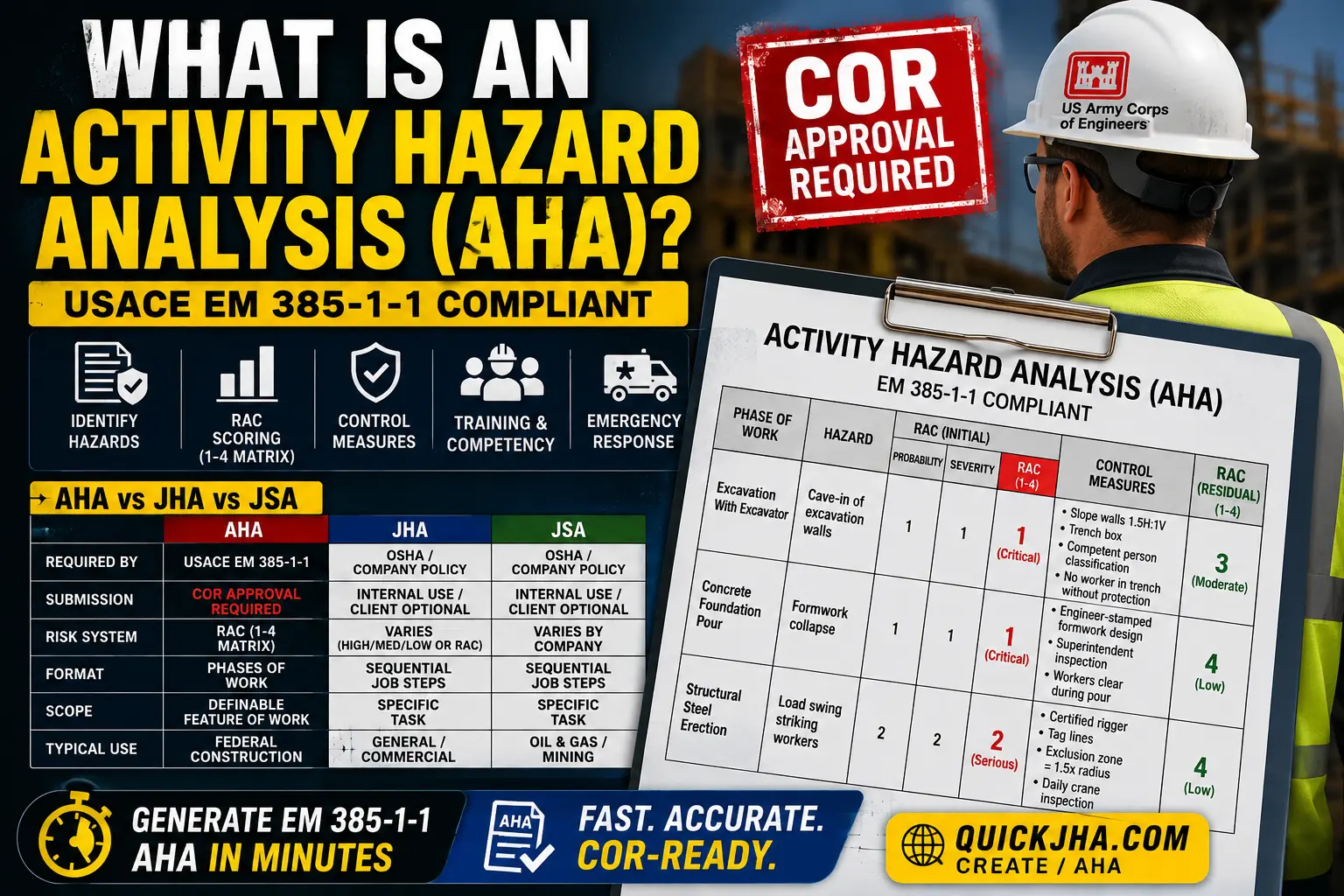
Document 2: AHA Checklist (USACE EM 385-1-1)
An activity hazard
analysis follows a stricter, federally defined format for USACE and similar
federal work:
•
Submitted
before mobilization: delivered to and accepted by the Government or
prime before the activity starts on site, per EM 385-1-1
•
Activity
clearly defined: the specific activity (not the whole project) is
named, matching the schedule of work
•
Sequence
of work steps: listed in execution order, with the associated
hazards for each step
•
Competent
or qualified person named: the individual responsible identified by
name and qualification
•
Equipment
to be used: all equipment listed, with applicable inspection or
certification requirements
•
Training
requirements specified: site-specific and activity-specific training
documented
•
Risk
Assessment Code (RAC) shown: both initial and residual RAC displayed
per hazard
•
Controls
tied to EM 385-1-1 sections: mitigation measures reference the
applicable chapter and section number
•
Reviewed
and updated: revisited and re-issued if scope, location, or method
changes mid-activity
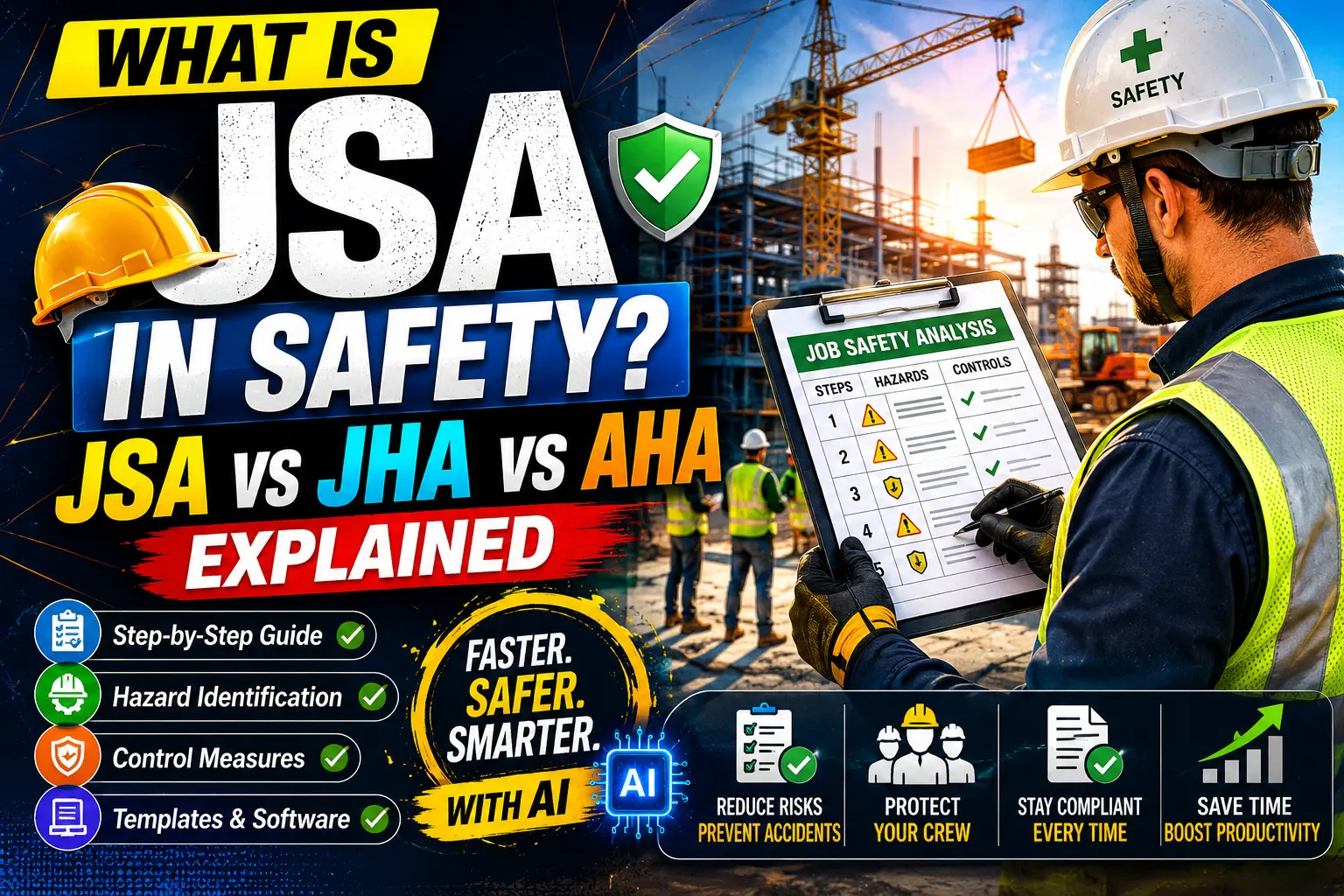
Document 3: JSA Checklist (Daily / Field-Level)
A job safety
analysis is typically the fastest of the three to complete and is meant to
reflect that specific day's work:
•
Completed
same-day, on-site: reflects that day's actual task and crew, not a
standing generic form
•
Crew
participation documented: all workers performing the task have
reviewed and signed
•
PPE
requirements itemized: specific PPE listed per step, not a blanket
“wear PPE” statement
•
Safe
work practices referenced: lockout/tagout, hot work permit, confined
space entry, cited where relevant
•
Environmental
and site conditions noted: weather, terrain, or nearby active
operations that change the risk profile
•
Emergency
response info included: nearest first aid, muster point, or
emergency contact referenced
•
Supervisor
sign-off: reviewed and approved by a supervisor or safety
representative before work begins
Global
Compliance Quick-Reference
Know which
framework governs your document before you submit. This is a starting
reference, not legal advice — always confirm current requirements with the
relevant regulator for your project.
|
REGION
|
PRIMARY
STANDARD(S)
|
WHAT TO CHECK
|
|
United States
|
OSHA 29 CFR 1910 (General
Industry) & 1926 (Construction); Cal/OSHA where applicable; USACE EM
385-1-1 for federal/military work
|
Confirm whether the project
is federal (AHA required) or private (JHA/JSA sufficient); check state-plan
variations — Cal/OSHA is stricter than federal OSHA in several areas
|
|
Australia
|
Work Health and Safety (WHS)
Act & Regulations (model law); Safe Work Australia codes of practice
|
Many clients also expect a
Safe Work Method Statement (SWMS) for high-risk construction work — confirm
which document your principal contractor requires
|
|
Canada
|
Canada Occupational Health
and Safety Regulations (COHSR); WorkSafeBC; CSA standards; provincial acts
|
Requirements vary by
province — verify the specific provincial regulator (WorkSafeBC, WSIB
Ontario, etc.) governing the job site
|
|
United Kingdom
|
Health and Safety at Work
etc. Act (HSWA); HSE guidance; CDM Regulations for construction
|
UK projects often use “risk
assessment / method statement” (RAMS) terminology — confirm your client's
preferred document naming
|
|
New Zealand
|
Health and Safety at Work
Act (HSWA-NZ)
|
Closely mirrors the
Australian model law — reuse AU-aligned hazard/control language with
NZ-specific citations
|
|
UAE / Gulf
|
OSHAD-SF (Abu Dhabi);
municipality and free-zone HSE codes elsewhere in the Gulf
|
International EPC
contractors often layer OSHA-style documentation on top of local code
requirements — confirm both are satisfied
|
Tip:
If you operate
across multiple regions, keep one master hazard library and map it to each
jurisdiction's citation format rather than rebuilding documents from scratch
per country.
Where Audits
and Prequalification Reviews Find Gaps
Across all three
document types, the same few gaps come up repeatedly:
•
Generic hazards copy-pasted
across unrelated tasks, with nothing tying them to the actual site or equipment
•
Missing residual risk an
initial rating is shown, but nothing after controls are applied
•
No named competent or
qualified person, particularly on AHAs where EM 385-1-1 expects one
•
PPE listed as a blanket
statement instead of itemized per step
•
No signature or date, which
makes the document unusable as evidence of pre-task review
Download Free📥 Download JHA Template - OSHA Cal-OSHA ANSI Compliant.docx