How to Write an Incident Report + Free Sample Template
A step-by-step guide to writing a safety incident report that meets OSHA recordkeeping requirements includes a free sample template, common mistakes to avoid, and how JHAs help prevent future incidents.
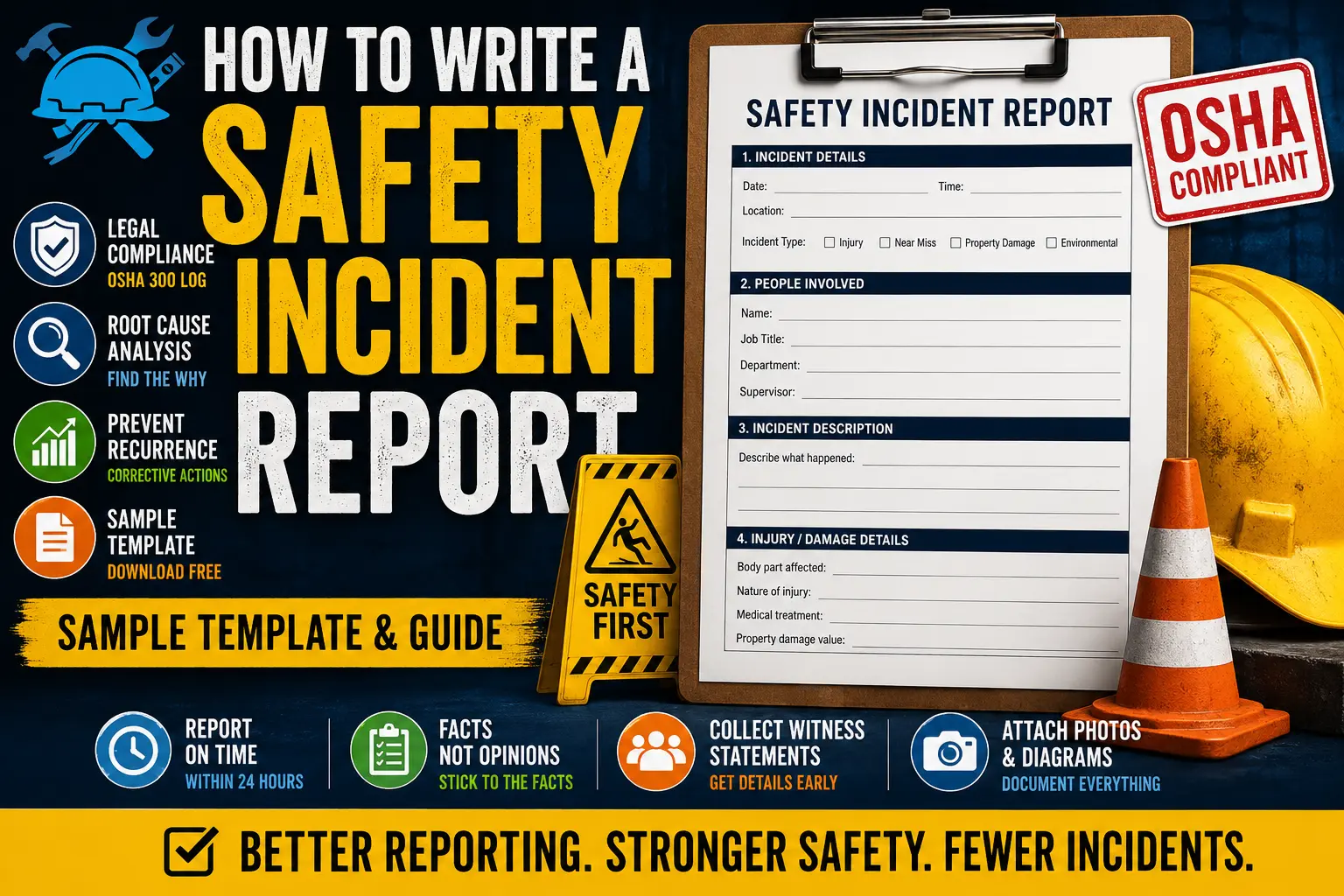
What Is a Safety Incident Report?
A safety incident report is a formal written record of any unplanned event in the workplace that resulted in or had the potential to result in injury, illness, property damage, or an environmental release. In occupational health and safety, incident reports serve multiple critical purposes:
- Legal compliance: OSHA requires certain incidents to be recorded on the OSHA 300 Log (29 CFR 1904)
- Root cause analysis: The report is the starting point for understanding why the incident occurred
- Prevention: Identifying root causes enables corrective actions that prevent recurrence
- Insurance and liability: Documented incidents support insurance claims and protect the company legally
- Safety trend analysis: A series of reports over time reveals patterns that can inform the safety programme
OSHA Recordable vs Non-Recordable Incidents
Not every workplace incident is an OSHA recordable. Understanding the distinction is critical for accurate TRIR reporting and OSHA log compliance.
|
OSHA Recordable (must be logged) |
NOT Recordable (first aid only) |
|
• Lost
time injury (1+ full days away) •
Restricted work / job transfer •
Medical beyond first aid • Loss
of consciousness |
• Minor
cuts/scrapes: one-time treatment only • OTC
medication (non-prescription dose) •
Tetanus shot as precaution • Single
healthcare visit, no treatment |
|
|
|
Step-by-Step: How to Write an Incident Report
- Secure the scene first: Before writing anything, ensure the scene is safe. Provide first aid, call emergency services if needed, and preserve the scene for investigation. Do not disturb physical evidence.
- Record basic information: Date, time, and exact location of the incident. Names of the injured person(s), witnesses, and the supervisor present. Equipment, tools, and materials involved.
- Describe what happened: Write a factual, chronological narrative of the events leading up to, during, and immediately following the incident. Use plain language. Avoid blame or speculation.
- Describe the injury or damage: Be specific: 'Laceration to right hand, palm, approximately 3cm, caused by contact with unguarded circular saw blade.' Document medical treatment given.
- Identify contributing factors: What conditions contributed to the incident? Include: environmental factors (wet floor, poor lighting), equipment condition, worker experience, procedure compliance, and time pressure.
- Determine the root cause: The root cause is the fundamental reason the incident occurred. Ask 'why' five times (5 Why analysis) to get past symptoms to the underlying cause.
- Document corrective actions: For every root cause identified, document a specific corrective action, the person responsible for completing it, and a completion deadline.
- Collect witness statements: Each witness should provide a written, signed statement describing what they saw. Collect statements as soon as possible while memories are fresh.
- Attach photographs and diagrams: Photos of the scene, equipment, and injuries (with permission) are essential. A site diagram showing the exact location adds context.
- Review and sign: The supervisor, safety officer, and where appropriate, the injured worker, should review and sign the completed report.

Recent Posts
JHA, AHA & JSA Compliance Checklist: What Auditors Check
A field-ready compliance checklist for JHAs, AHAs, and JSAs, covering US, Australian, Canadian, UK, New Zealand, and UAE standards, plus what auditors flag. Primary Keyword: checklist for job safety analysis jsa consists of
Sep 22, 2026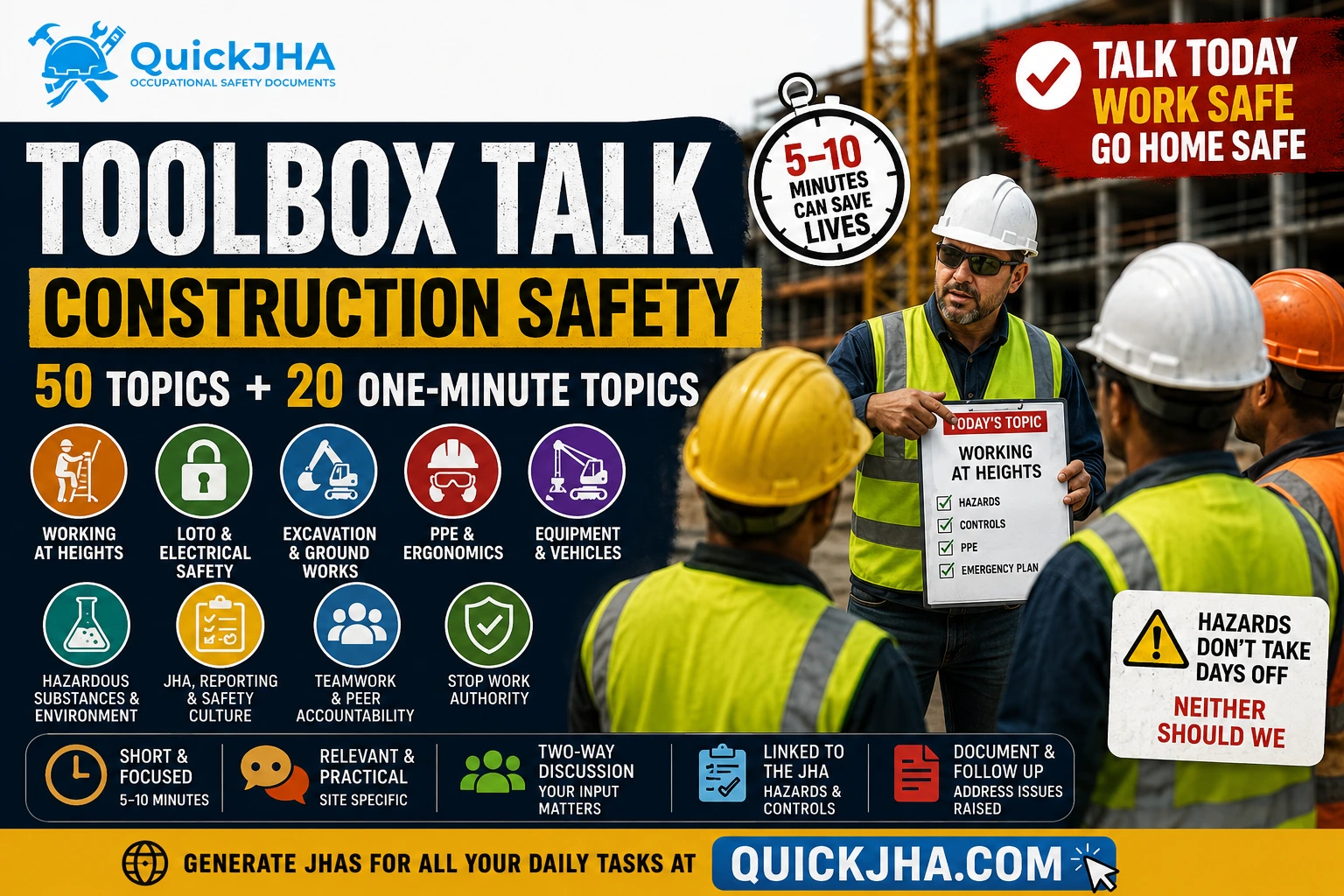
50 Toolbox Talk Topics for Construction Safety Meetings (2026)
A complete list of 50 toolbox talk topics for construction safety meetings, 20 quick one-minute safety topics, tips for running effective talks, and how to link your toolbox talk programme to your JHA system.
Jul 06, 2026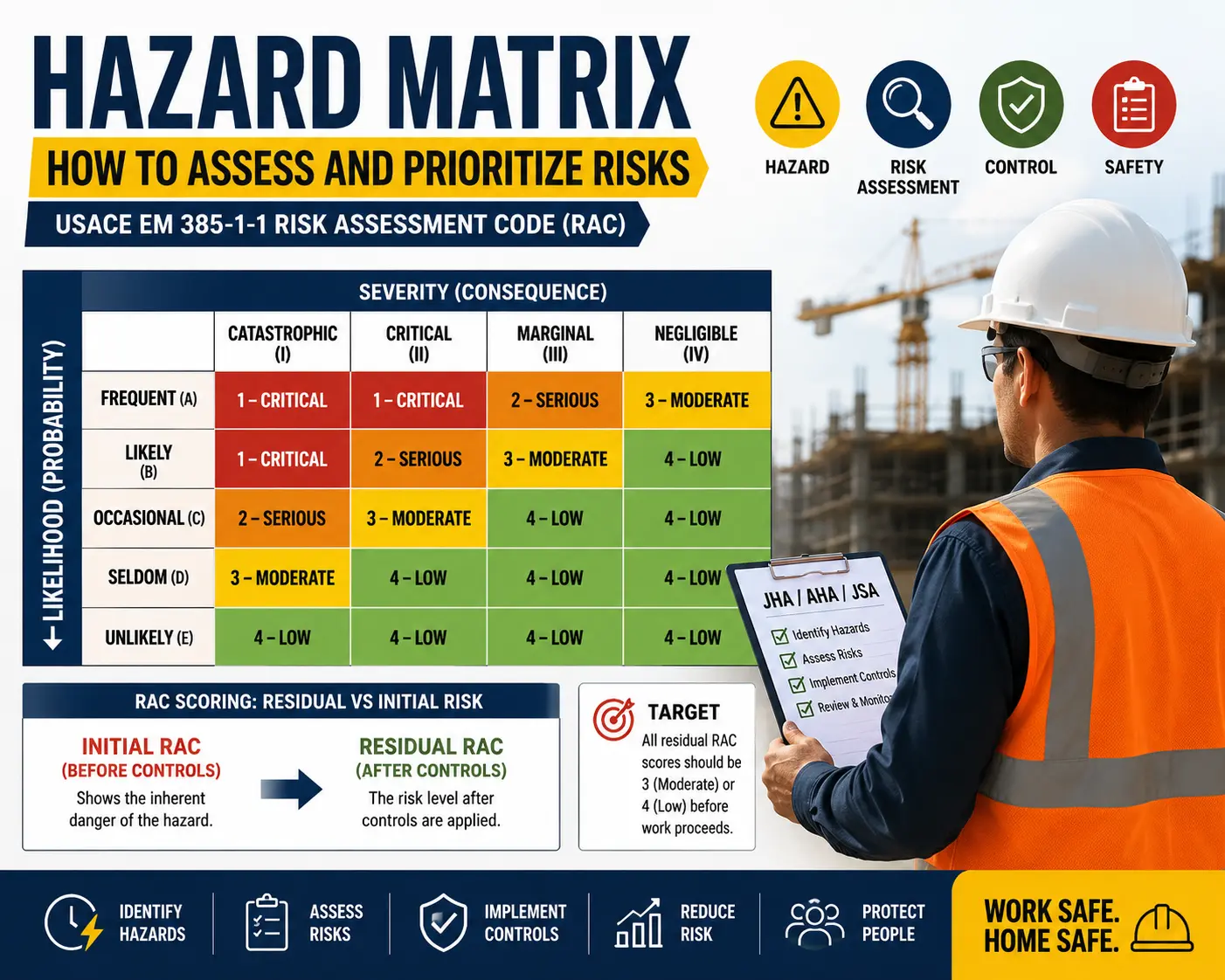
Hazard Matrix: How to Use a Risk Assessment Matrix in Safety
Understand how a hazard matrix works, how to read likelihood × severity risk ratings, what RAC scores mean, and how to apply a risk assessment matrix correctly inside JHA and AHA documents.
Jun 30, 2026
How to Inspect a Construction Site for Safety: 10-Step Guide
A complete guide to construction site safety inspections including an OSHA 29 CFR 1926 checklist, a 10-step inspection process, common violations, and how JHA documentation supports pre-inspection planning.
Jun 25, 2026
How to Calculate TRIR: Step-by-Step Guide with Formula & Examples
Learn what TRIR means, the exact formula for calculating Total Recordable Incident Rate, worked examples, what a good TRIR score looks like, and how JHA documentation helps you reduce it.
Jun 24, 2026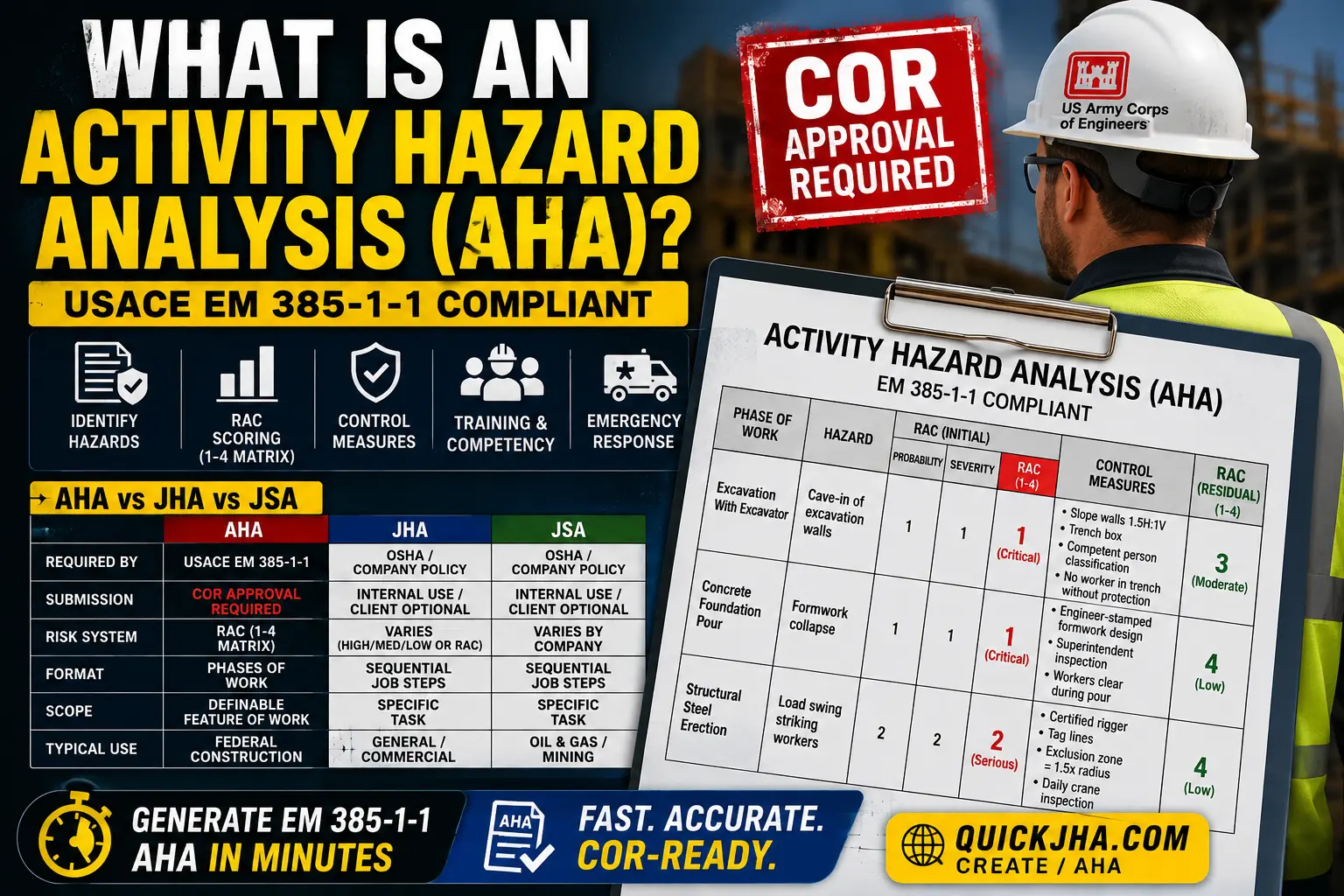
Activity Hazard Analysis (AHA) Guide for EM 385-1-1
The complete guide to Activity Hazard Analysis (AHA) for USACE and federal contractors. Understand EM 385-1-1 requirements, AHA format, real construction examples, and how to generate a compliant AHA in minutes.
Jun 22, 2026Generate Safety Documents in Seconds
Create OSHA-compliant JHAs, AHAs, and JSAs instantly. Professional formatting, zero effort, built for safety professionals.