JHA Template Free Download + How to Use It
Download a free JHA template, learn how to fill it out step by step, avoid the most common mistakes, and discover why an AI-generated JHA saves hours compared to a blank form.
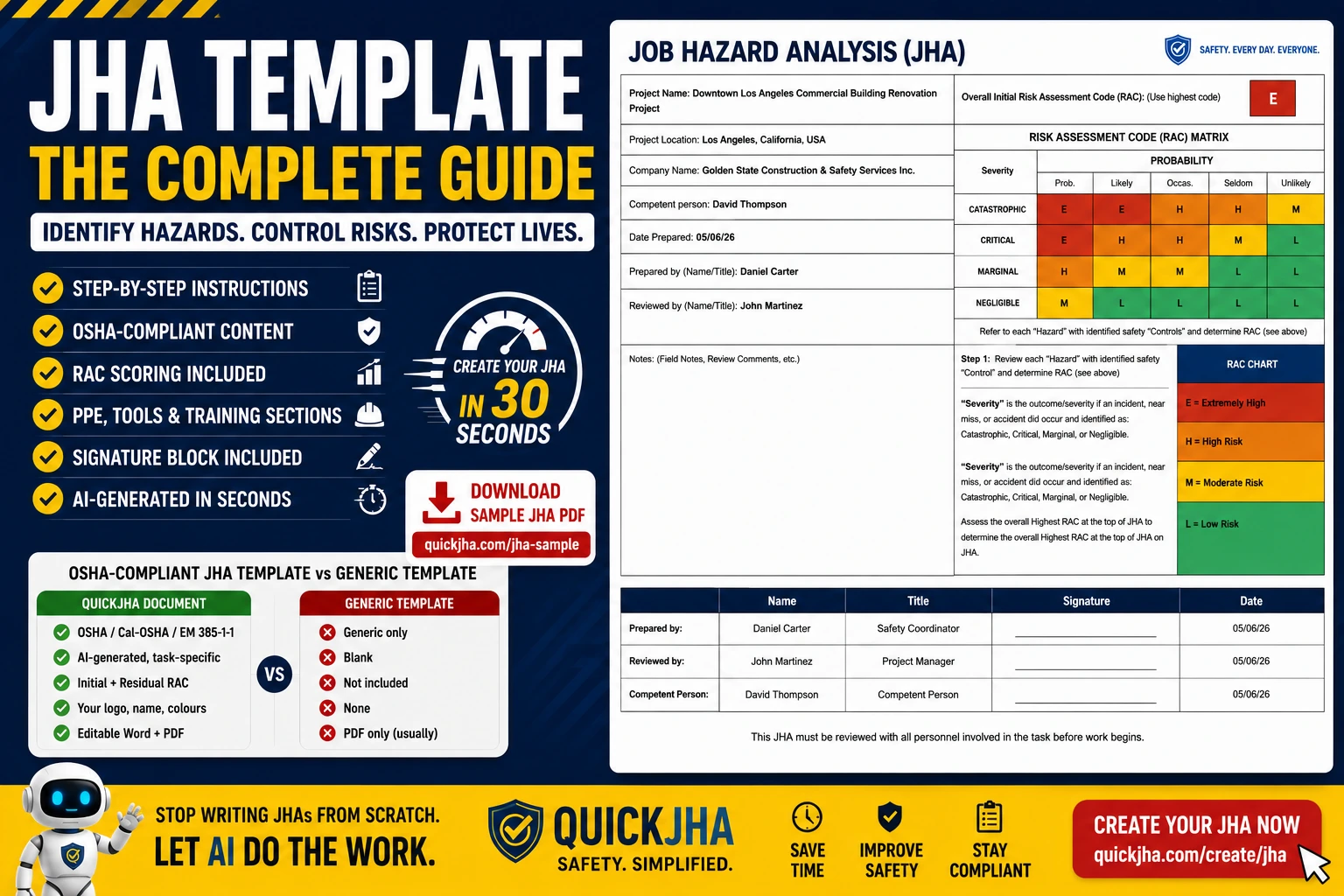
What Should a JHA Template Include?
A JHA template is not just a blank table. A properly structured template guides the user through every element required by OSHA and international safety standards, ensuring nothing critical is missed. Here is what every JHA form must contain:
- Header Information: Project name, date, location, company name, supervisor, and document number
- PPE Section: Checkboxes or a list of all PPE required before the task begins
- Tools & Equipment: A field to document every tool, machine, or piece of equipment used
- Task Step Column: Numbered list of each step in the job, in sequence
- Potential Hazard Column: Description of what could go wrong at each step
- Initial RAC Score: Risk level before any controls are applied
- Potential Hazards: For each step, what could go wrong (e.g. 'fall from height', 'electrical contact')
- Control Measures Column: Specific actions to eliminate or mitigate each hazard
- Residual RAC Score: Risk level after controls are in place
- Training Required: Certifications, licences, or training needed
- Signature Block: Worker, supervisor, and safety officer signatures with dates
How to Fill Out a JHA Form Step by Step
- Complete the header: Fill in the project name (be specific), location, date, and company. Add the supervisor's name and document number if you use a numbering system.
- List required PPE: Before writing a single job step, identify all PPE the worker must wear. This includes hard hat, safety glasses, gloves, high-visibility vest, steel-toe boots, and any task-specific PPE such as a harness or arc flash suit.
- List tools and equipment: Document every tool, piece of machinery, and equipment that will be used. This helps identify tool-specific hazards later.
- Break the task into sequential steps: Write out the task from start to finish in the order it will actually be performed. Aim for 6–12 steps. Each step should describe an action, not a hazard.
- Identify hazards for each step: For every step, ask: 'What could hurt someone here?' Consider energy types (kinetic, electrical, chemical, gravitational), environmental factors (weather, confined spaces, traffic), and human factors (fatigue, inexperience).
- Score the initial risk (RAC): For each hazard, rate it based on Likelihood (Probable, Occasional, Remote, Improbable) and Severity (Catastrophic, Critical, Marginal, Negligible). Their combination gives your RAC score.
- Write control measures: For each hazard, document specific actions that will reduce the risk. Follow the hierarchy: eliminate the hazard first, then substitute, then engineering controls, then administrative controls, then PPE.
- Score the residual risk: After controls, re-rate the risk. If the residual RAC is still Critical or Serious, you need stronger controls.
- Obtain signatures: Every worker who will perform the task must read and sign the JHA. The supervisor and safety officer must also sign before work begins.
Common Mistakes on JHA Forms
Why AI-Generated JHA is Better Than a Blank Template
A blank template is a starting point, nothing more. It gives you a structure but provides no content. When you open a blank JHA form, you still need to:
QuickJHA's AI does all of this automatically. You enter the task and location the AI generates a complete, pre-populated JHA with hazards, controls, and risk scores that a trained safety professional would recognise as thorough and accurate. The result is a document that would take an experienced safety officer 60–90 minutes to produce manually, delivered in under 30 seconds.
OSHA-Compliant JHA Template vs Generic Template
|
Feature |
Generic Template |
QuickJHA Document |
|
Regulation-specific content |
✗ Generic only |
✓ OSHA / Cal-OSHA / EM 385-1-1 |
|
Pre-populated hazards |
✗ Blank |
✓ AI-generated, task-specific |
|
RAC scoring |
✗ Not included |
✓ Initial + Residual RAC |
|
Company branding |
✗ None |
✓ Your logo, name, colours |
|
Editable Word + PDF |
PDF only (usually) |
✓ Both formats included |

Recent Posts
JHA, AHA & JSA Compliance Checklist: What Auditors Check
A field-ready compliance checklist for JHAs, AHAs, and JSAs, covering US, Australian, Canadian, UK, New Zealand, and UAE standards, plus what auditors flag. Primary Keyword: checklist for job safety analysis jsa consists of
Sep 22, 2026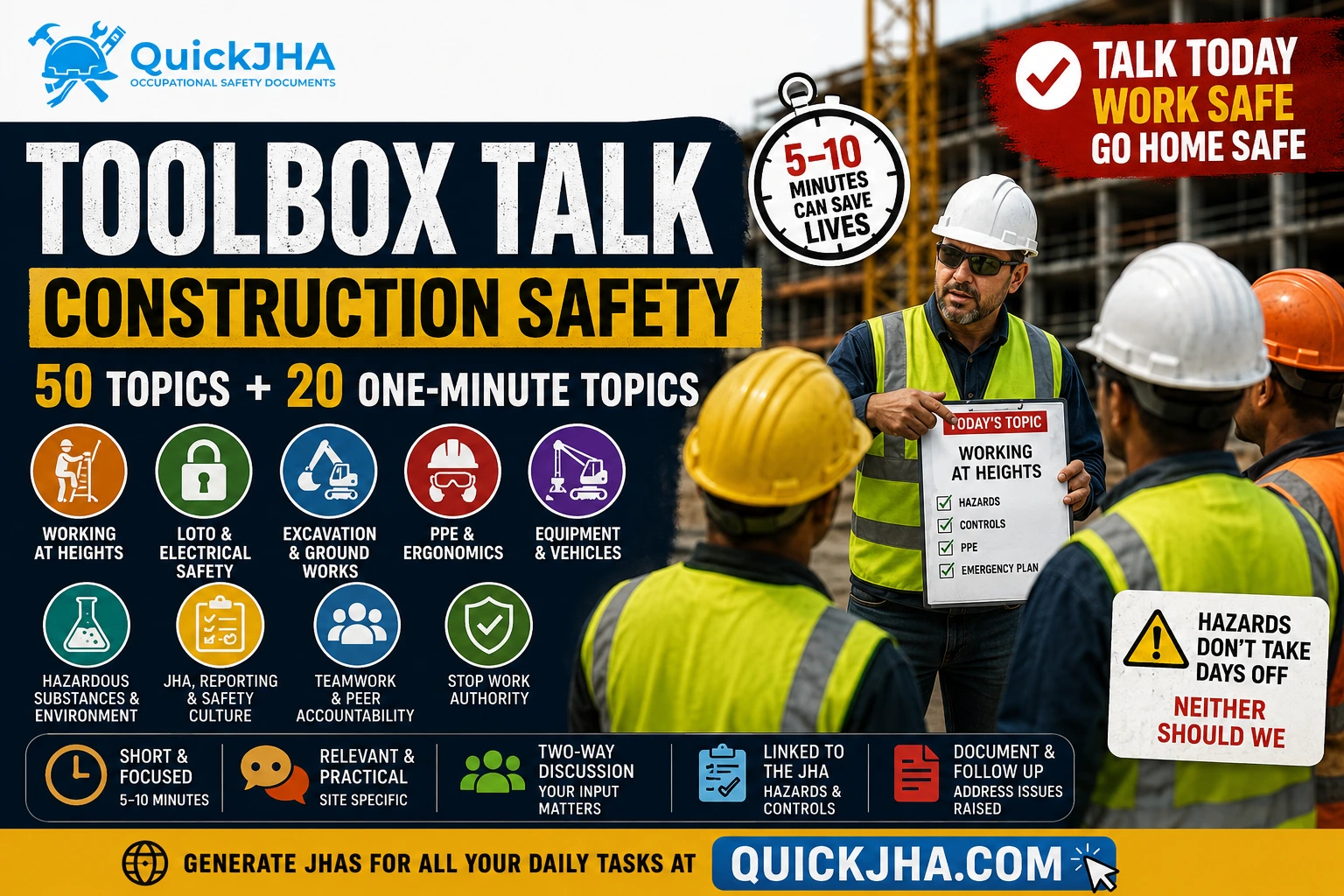
50 Toolbox Talk Topics for Construction Safety Meetings (2026)
A complete list of 50 toolbox talk topics for construction safety meetings, 20 quick one-minute safety topics, tips for running effective talks, and how to link your toolbox talk programme to your JHA system.
Jul 06, 2026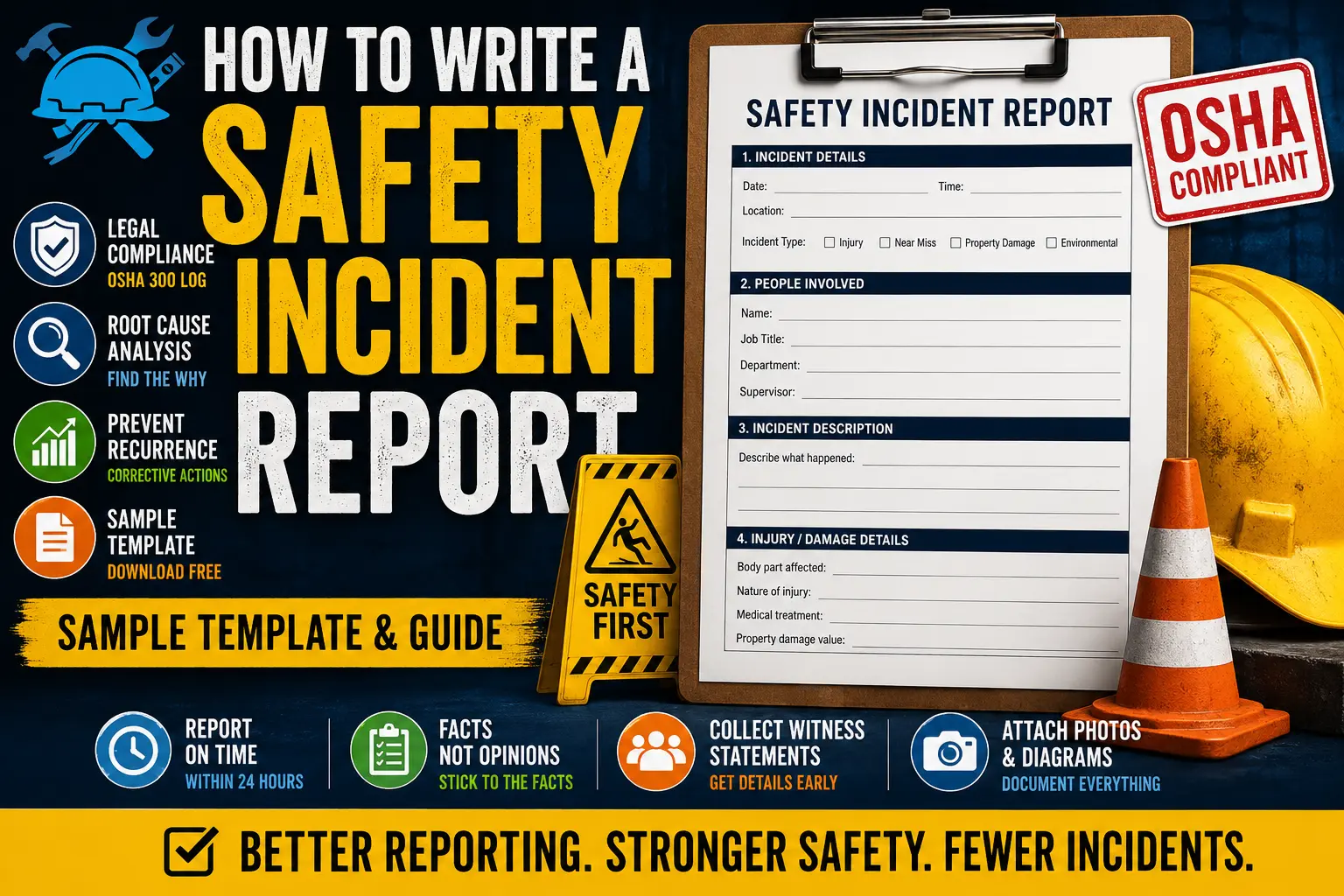
How to Write an Incident Report + Free Sample Template
A step-by-step guide to writing a safety incident report that meets OSHA recordkeeping requirements includes a free sample template, common mistakes to avoid, and how JHAs help prevent future incidents.
Jul 03, 2026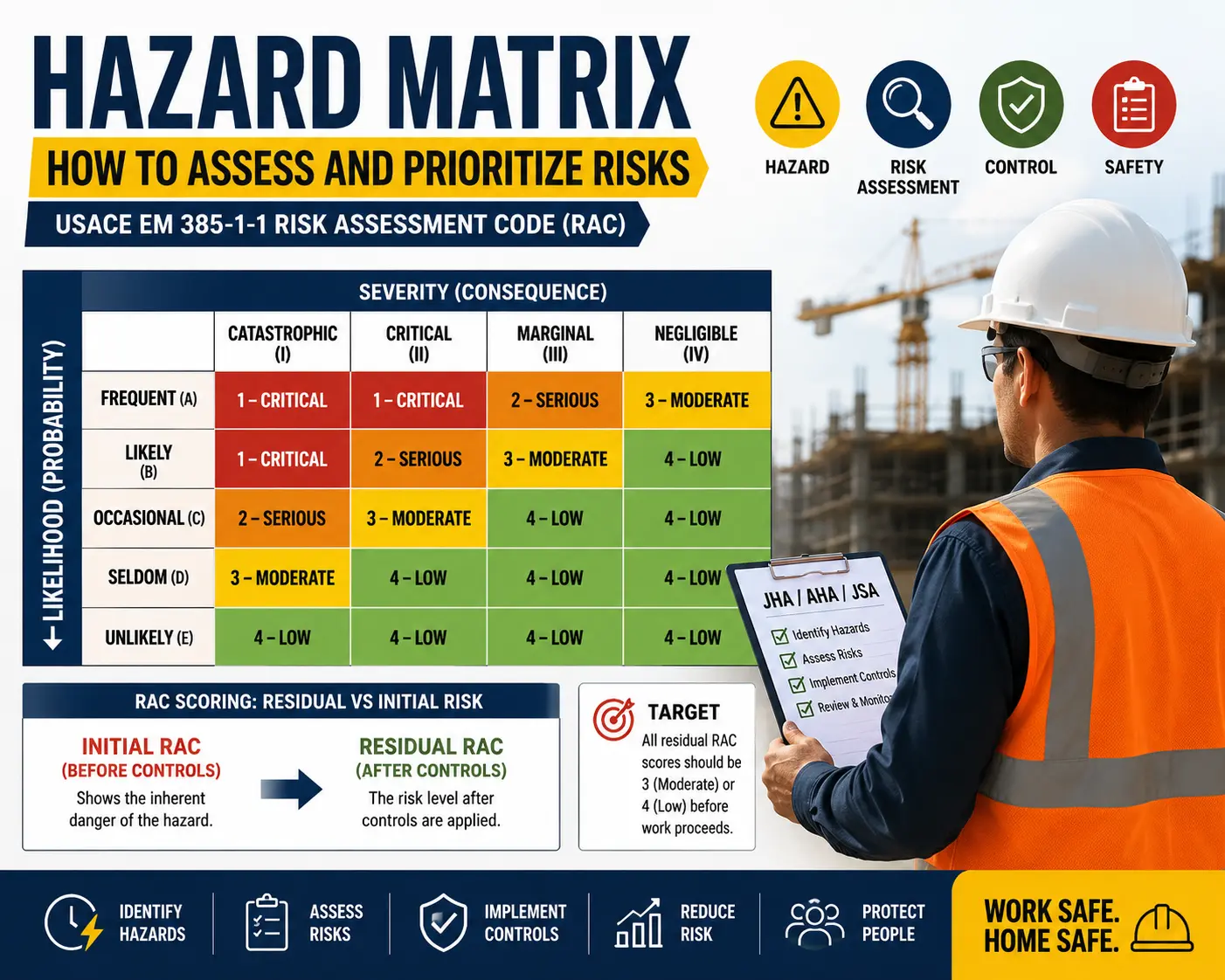
Hazard Matrix: How to Use a Risk Assessment Matrix in Safety
Understand how a hazard matrix works, how to read likelihood × severity risk ratings, what RAC scores mean, and how to apply a risk assessment matrix correctly inside JHA and AHA documents.
Jun 30, 2026
How to Inspect a Construction Site for Safety: 10-Step Guide
A complete guide to construction site safety inspections including an OSHA 29 CFR 1926 checklist, a 10-step inspection process, common violations, and how JHA documentation supports pre-inspection planning.
Jun 25, 2026
How to Calculate TRIR: Step-by-Step Guide with Formula & Examples
Learn what TRIR means, the exact formula for calculating Total Recordable Incident Rate, worked examples, what a good TRIR score looks like, and how JHA documentation helps you reduce it.
Jun 24, 2026Generate Safety Documents in Seconds
Create OSHA-compliant JHAs, AHAs, and JSAs instantly. Professional formatting, zero effort, built for safety professionals.