What is an Activity Hazard Analysis?
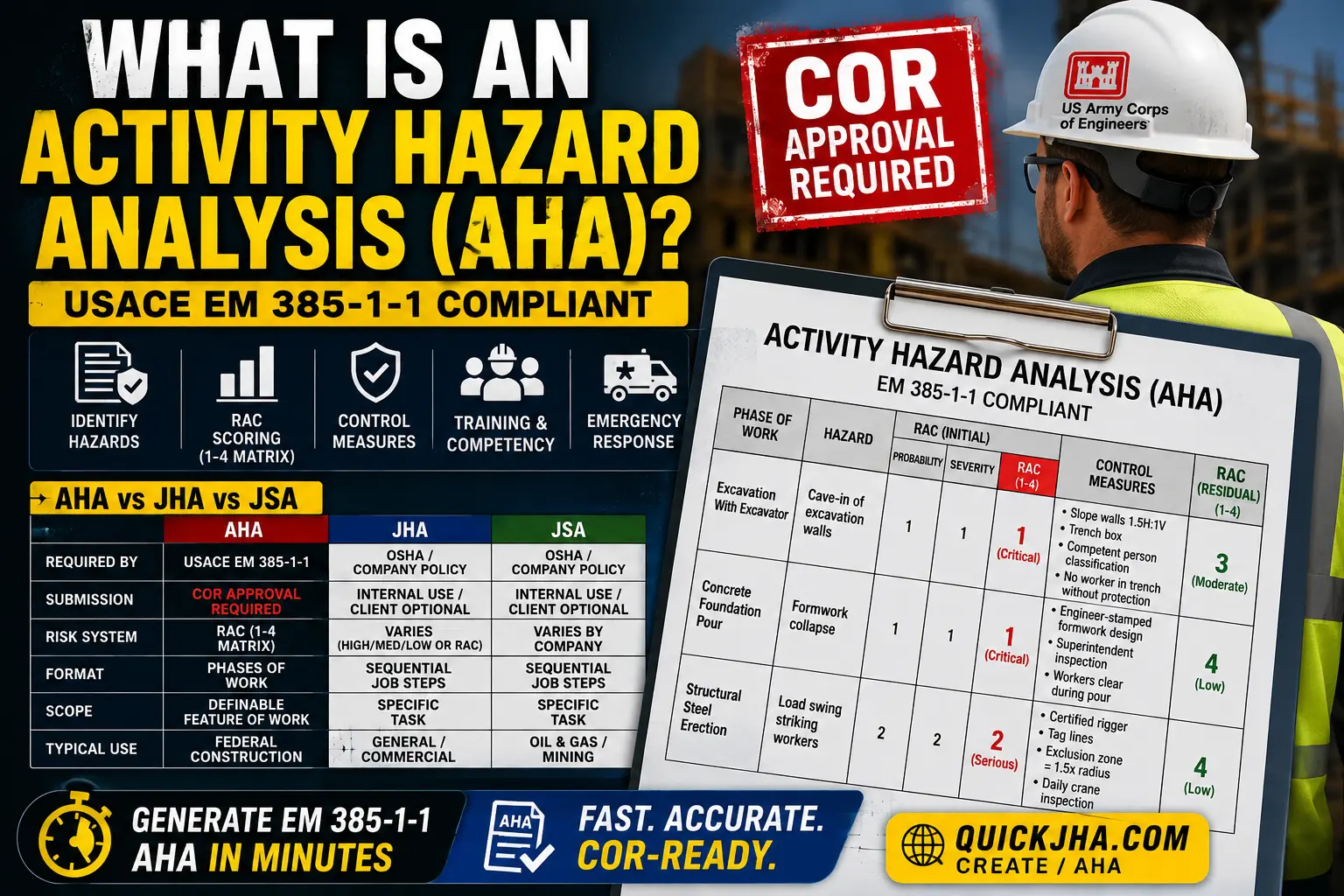
An Activity Hazard Analysis (AHA) is a formal safety planning document required on all US Army Corps of Engineers (USACE) construction projects and many other federal contracting environments. The AHA identifies every hazard associated with a specific definable feature of work (DFOW), assesses the risk using the USACE Risk Assessment Code (RAC) system, and documents the controls that will be implemented before, during, and after each activity.
Think of the AHA as the federal government's version of a Job Hazard Analysis. It requires more detail, formal RAC scoring, and submission to the Contracting Officer Representative (COR) for approval before any work in that phase begins.
AHA vs JHA vs JSA Complete Comparison
|
Attribute
|
AHA
|
JHA
|
JSA
|
|
Required by
|
USACE EM
385-1-1
|
OSHA /
Company policy
|
OSHA /
Company policy
|
|
Submission
|
COR
approval required
|
Internal
use / client optional
|
Internal
use / client optional
|
|
Risk system
|
RAC (1–4
matrix)
|
Varies
(High/Med/Low or RAC)
|
Varies
by company
|
|
Format
|
Phases
of work
|
Sequential
job steps
|
Sequential
job steps
|
|
Scope
|
Definable
feature of work
|
Specific
task
|
Specific
task
|
|
Typical use
|
Federal
construction
|
General
/ commercial
|
Oil
& gas / mining
|
EM 385-1-1: What Is It and Why Does It Matter?
EM 385-1-1 is the US Army Corps of Engineers Safety and Health Requirements Manual. It is one of the most comprehensive construction safety standards in the world, covering everything from general safety planning to specific requirements for demolition, underwater construction, and explosives handling.
If you are a contractor working on any USACE project, compliance with EM 385-1-1 is contractually mandatory. Failure to produce a compliant AHA before work begins can result in work stoppage orders, contract penalties, or removal from the project.
An Accident Prevention Plan (APP) must be submitted before mobilisation
An AHA must be prepared for each definable feature of work (DFOW)
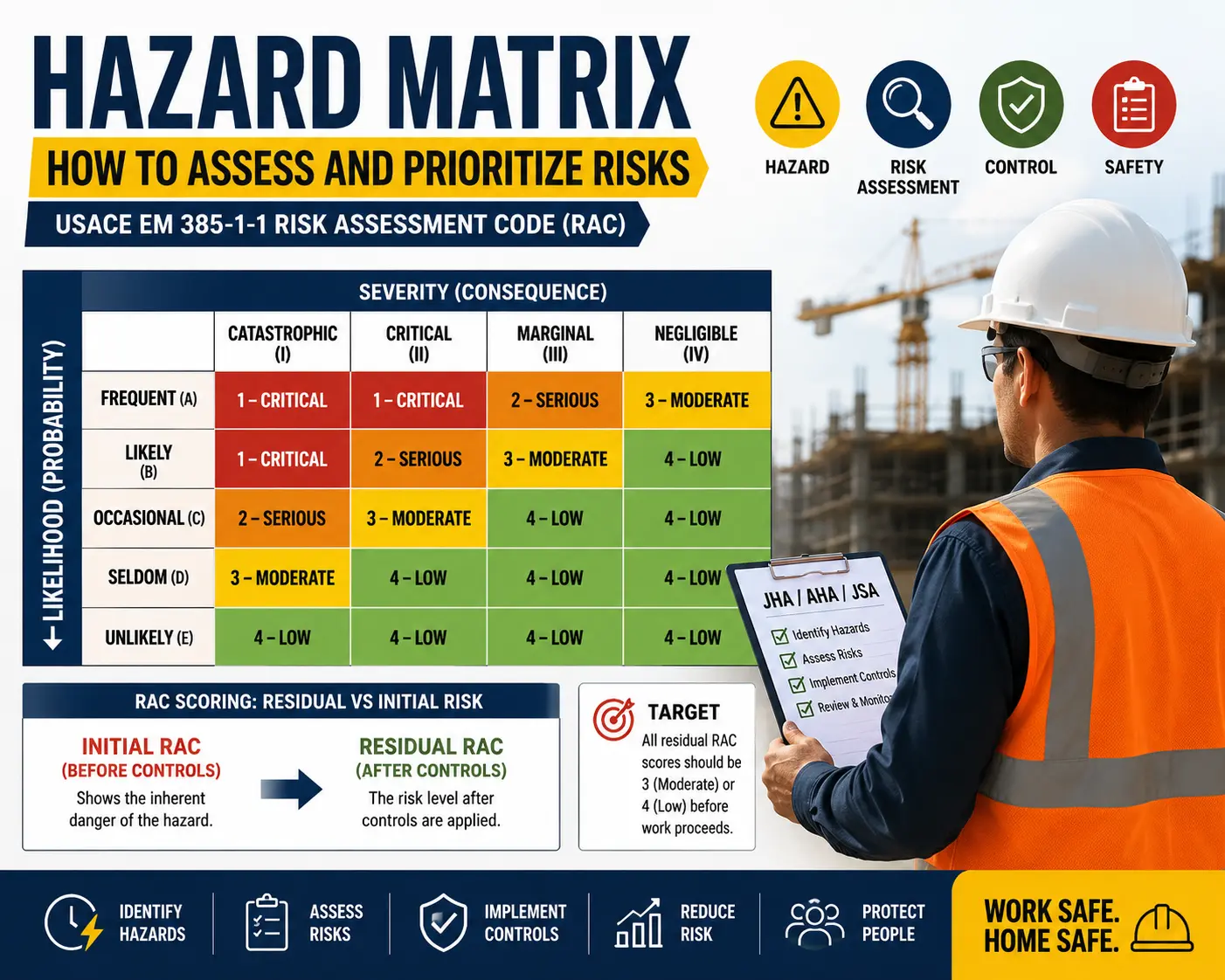
Each AHA must use the USACE RAC scoring matrix (Likelihood × Severity = RAC 1–4)
The AHA must be signed by the superintendent and safety officer
The AHA must be submitted to and approved by the COR before work in that phase begins
AHAs must be updated whenever significant changes occur to the work or site conditions
AHA Format Required by USACE Section by Section
Project Identification: Project name, contract number, location, contractor name
Definable Feature of Work (DFOW): The specific activity being analysed (e.g. 'Reinforced Concrete Foundation Pour')
Phases of Work: The sequential phases/steps of the activity
Hazard Identification: All hazards associated with each phase
RAC (Initial): Risk Assessment Code before controls are applied (matrix: Probability × Severity)
Control Measures: Specific engineering, administrative, and PPE controls for each hazard
RAC (Residual): Risk after controls are applied. All residual RAC scores must be 3 (Moderate) or 4 (Low) to proceed
Training Required: Certifications, OSHA 10/30 cards, equipment operator licences
Inspection Requirements: What inspections are required and who performs them
Emergency Response: Emergency contacts, nearest hospital, emergency procedures
Signature Block: Superintendent, Safety Officer, and COR approval
Structural Steel Erection AHA
Excavation AHA
Mechanical excavation using track excavator. Hazard: Cave-in of excavation walls. Initial RAC: 1 (Critical). Controls: Slope walls to 1.5H:1V or install trench box; soil classification by competent person; no worker in trench without protection. Residual RAC: 3 (Moderate).
Concrete Foundation Pour AHA
Pouring and vibrating concrete. Hazard: Formwork collapse under concrete weight. Initial RAC: 1 (Critical). Controls: Formwork design stamped by licensed engineer; inspection by superintendent before pour begins; workers clear of formwork during initial pour. Residual RAC: 4 (Low).
Structural Steel Erection AHA
Hoisting steel columns with crane. Hazard: Load swing striking workers. Initial RAC: 2 (Serious). Controls: Rigging by certified rigger only; tag lines on all lifts; exclusion zone = 1.5x maximum load radius; daily crane inspection log maintained. Residual RAC: 4 (Low).
Common AHA Mistakes That Fail Compliance Review
Generic hazard descriptions: 'Falls' is not acceptable. Write 'fall from edge of concrete formwork at 4m height'.
Missing residual RAC scores: Every hazard must have both initial and residual RAC. A residual RAC of 1 or 2 means your controls are insufficient — add more controls.
Incomplete training section: All required certifications must be listed. Operators of cranes and forklifts must hold current licences.
No emergency response plan: EM 385-1-1 requires emergency contacts, nearest hospital address, and evacuation procedures.
Submitting without a superintendent's signature: The AHA has no standing without proper signatures. The COR will reject it.
Failing to update after scope changes: If the method of work changes, the AHA must be revised and resubmitted before the changed work begins.
How to Generate an AHA in Minutes with QuickJHA
QuickJHA is the only tool built specifically to generate EM 385-1-1 compliant AHA documents in under 30 seconds. Enter your project name, the definable feature of work, and select 'EM 385-1-1' as your regulatory standard. The AI generates a complete AHA with phases of work, hazard identification, RAC scoring (initial and residual), control measures, and all required sections ready for superintendent review and COR .
Create your AHA now