Introduction: Why Every Job Needs a Hazard Analysis
Every year, thousands of workers are injured or worse because hazards were not identified before work began. According to OSHA, the majority of workplace accidents are preventable when teams take the time to analyse what could go wrong before picking up a tool. A Job Hazard Analysis (JHA) is the most practical, proven method to do exactly that. Whether you are a new safety officer stepping onto your first job site, a site supervisor managing a crew of twenty, or a student studying occupational health, understanding what a JHA is and how to write one is a fundamental skill that could save lives.
Definition: What Is a Job Hazard Analysis (JHA)?
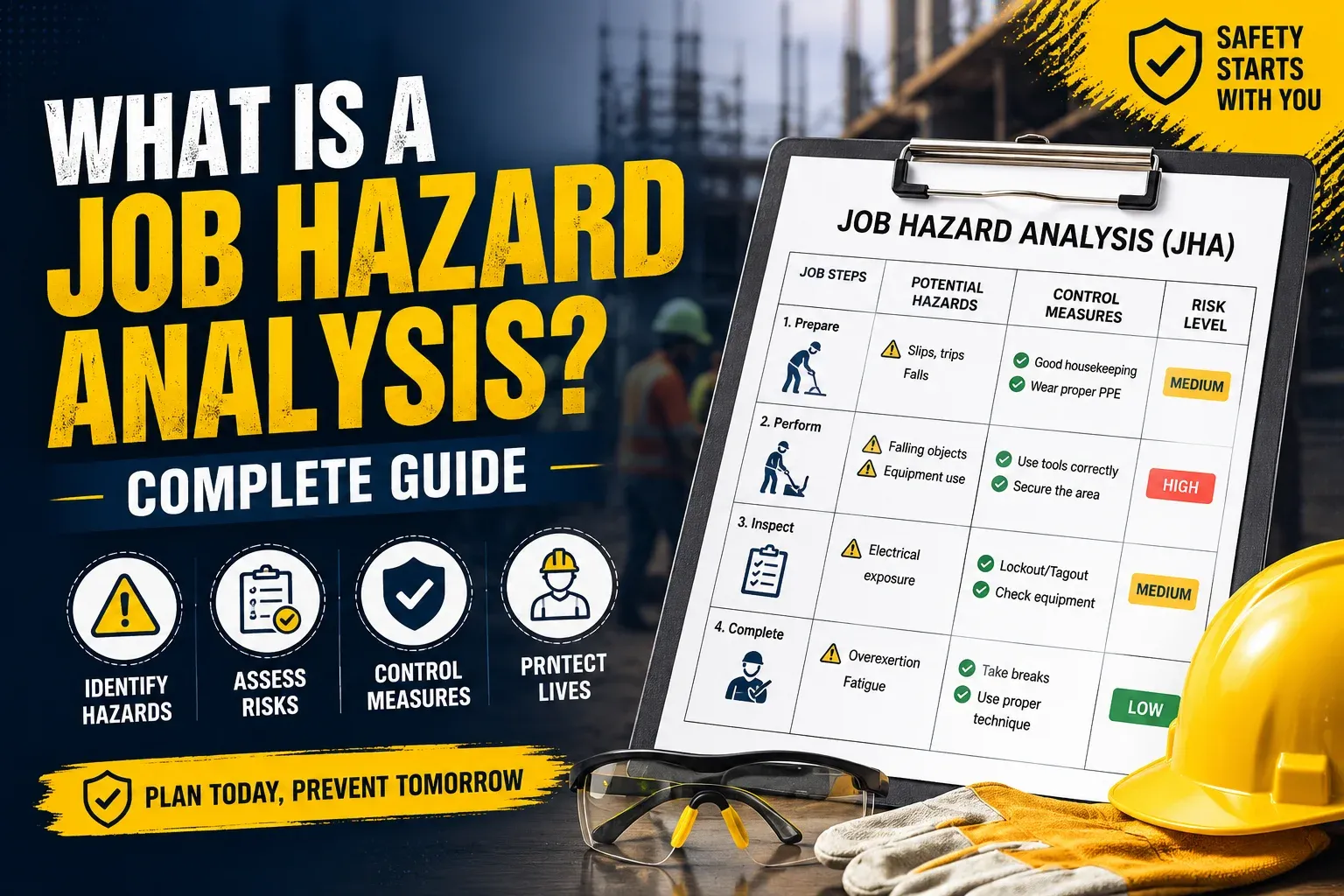
A Job Hazard Analysis, commonly abbreviated as JHA, is a structured process that breaks a job or task into individual steps, identifies the hazards associated with each step, and documents the controls needed to eliminate or reduce those hazards to an acceptable level.
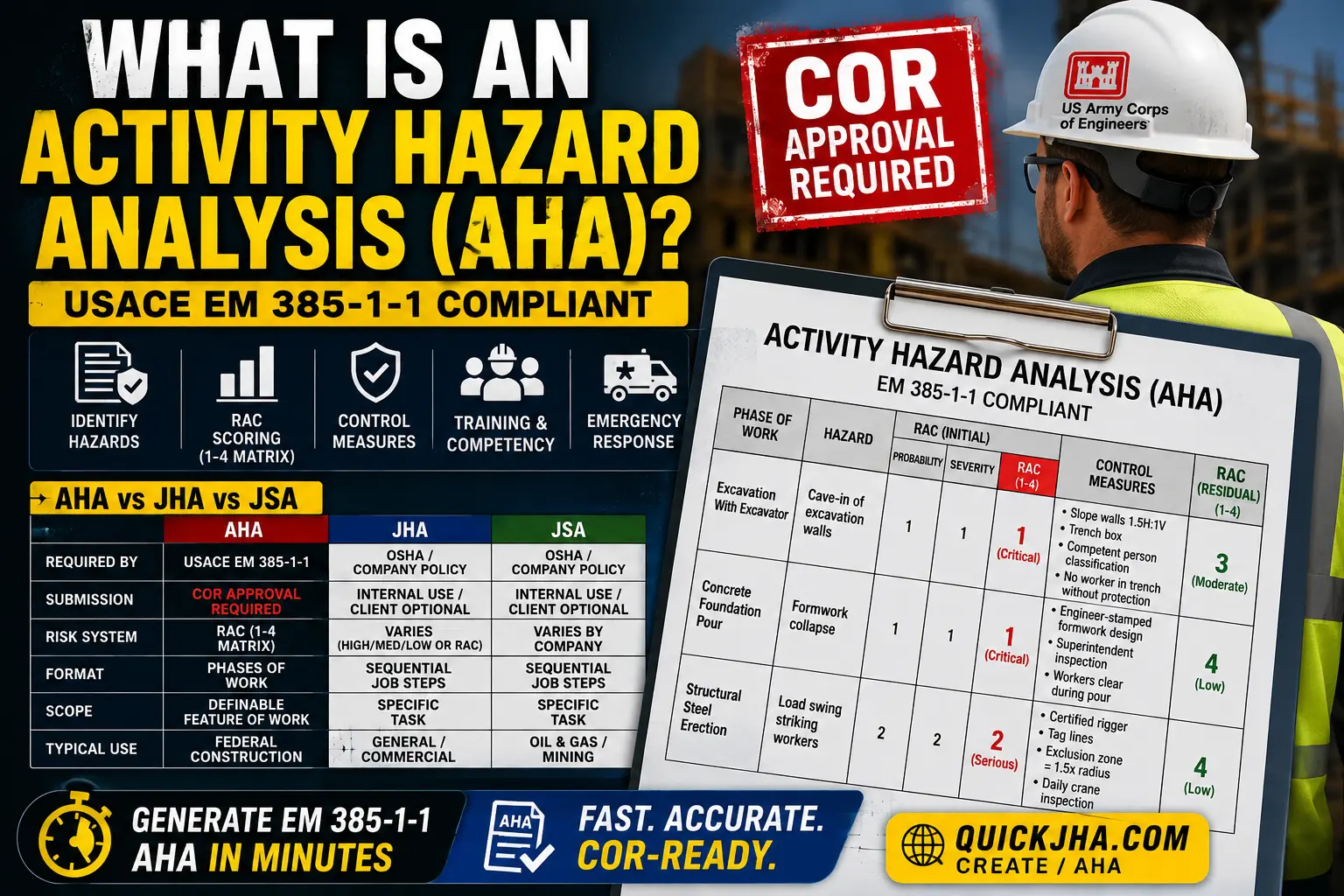
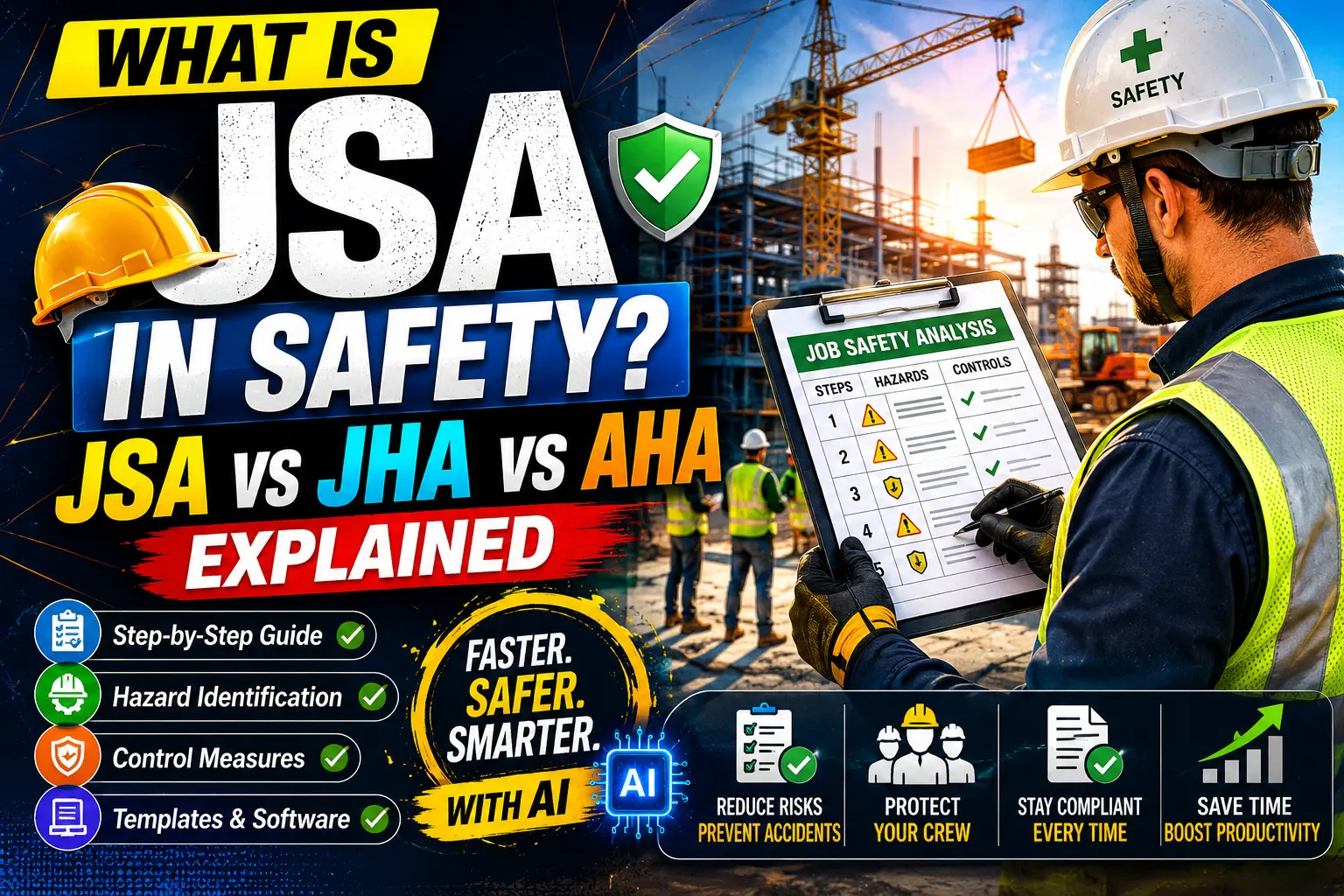
The JHA is sometimes called a Job Safety Analysis (JSA) or, on US Army Corps of Engineers (USACE) projects, an Activity Hazard Analysis (AHA). While the names differ, the core purpose is the same: identify hazards before work starts, not after an incident occurs.
OSHA defines a hazard analysis as the identification of undesired events that lead to the materialisation of a hazard, the analysis of the mechanisms by which those undesired events could occur, and the estimation of the likelihood and consequences of those events.
Key Components of a JHA Form
A complete, OSHA-compliant JHA form includes the following sections:
- Project / Job Title: The specific task being analysed (e.g. 'Scaffold Erection Level 3')
- Date & Location: When and where the work takes place
- Company & Supervisor: Who is responsible for the work
- Personal Protective Equipment (PPE) Required: List of mandatory PPE before work begins
- Tools & Equipment: Everything needed to complete the task safely
- Job Steps: A numbered, sequential breakdown of each step in the task
- Potential Hazards: For each step, what could go wrong (e.g. 'fall from height', 'electrical contact')
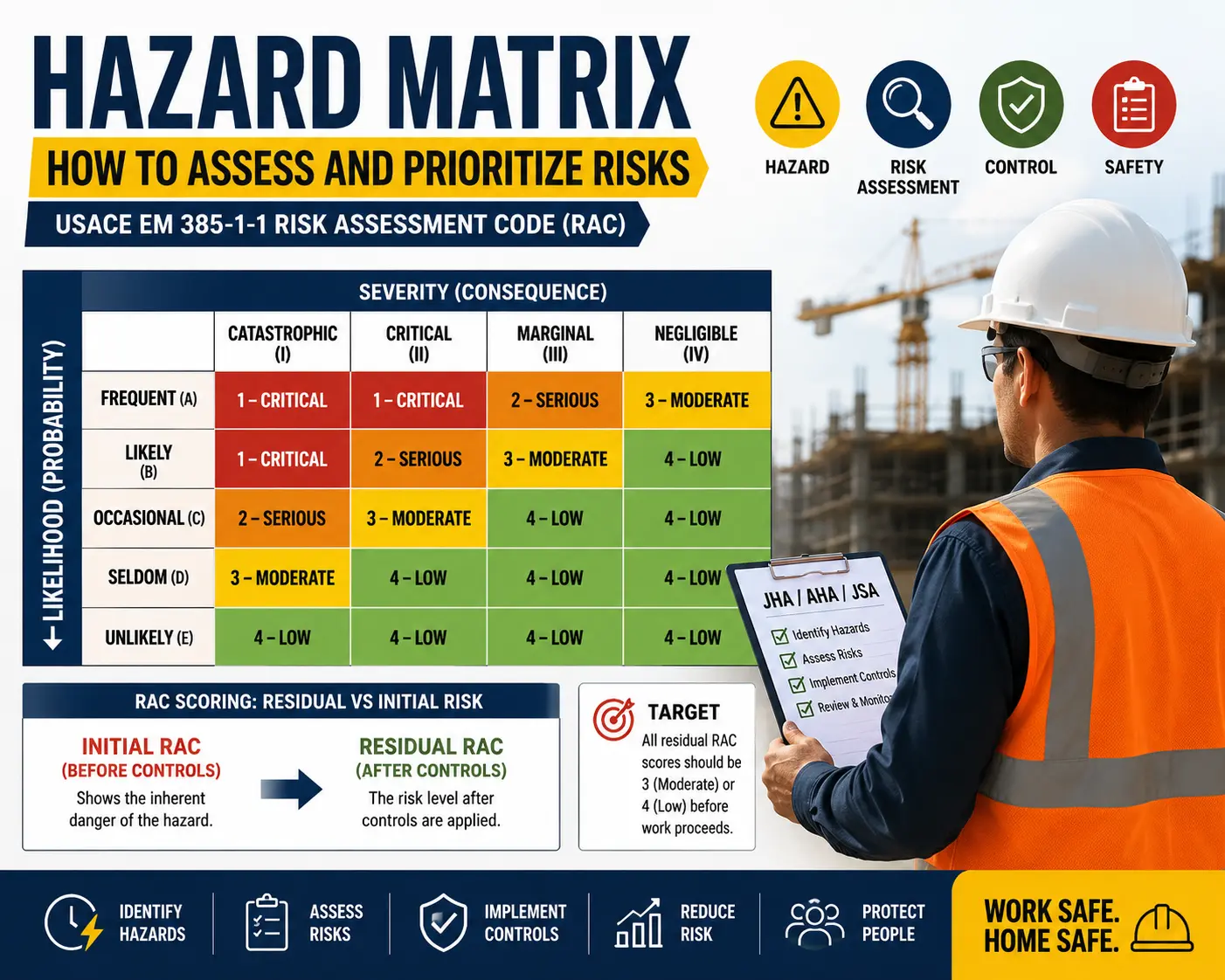
- Risk Assessment (RAC Score): Likelihood × Severity rating before controls are applied
- Control Measures: Engineering controls, administrative controls, and PPE to mitigate each hazard
- Residual Risk Rating: Risk level after controls are applied
- Training Required: Any certifications or training workers must have before performing the task
- Signatures: Supervisor, workers, and safety officer acknowledgement
5 Real Job Hazard Analysis Examples
1. Scaffold Erection (Construction)
Lifting scaffold tubes to upper platform. Hazard: Falling objects striking workers below. Control: Establish exclusion zone, use tag lines, ensure workers below wear hard hats. RAC Before: High. RAC After: Low.
2. Electrical Panel Maintenance
Opening a live electrical panel. Hazard: Arc flash / electrocution. Control: Lockout/Tagout (LOTO) procedure, arc flash PPE (Category 2 minimum), written LOTO permit. RAC Before: Serious. RAC After: Low.
3. Confined Space Entry
Worker entering a manhole. Hazard: Oxygen deficiency, toxic gas accumulation. Control: Continuous atmospheric monitoring, ventilation blower running before and during entry, trained attendant at entry point, rescue plan in place. RAC Before: Critical. RAC After: Medium.
4. Excavation Work
Operating an excavator within 3 metres of underground utilities. Hazard: Striking buried gas, water, or electrical lines. Control: Obtain utility locates (dial before you dig), hand-dig within 1 metre of marked utilities, spotter on the ground at all times. RAC Before: Serious. RAC After: Low.
5. Roof Work / Fall Hazard
Installing roofing membrane at the edge of the roof. Hazard: Fall from the roof edge. Control: Safety harness and lanyard anchored to a certified anchor point, guardrails installed, and roof edge awareness training completed. RAC Before: Critical. RAC After: Low.
Step-by-Step: How to Write a JHA
- Select the task: Choose a specific job task, not a broad activity. Instead of 'roofing', use 'installing metal roof sheets on a pitched roof'.
- Break the job into steps: List each step in the order it happens. Aim for 5–15 steps. Too broad misses hazards; too detailed becomes unworkable.
- Identify hazards for each step: Ask: What could injure someone here? Think about energy sources (gravity, electrical, chemical, mechanical), environment, and human factors.
- Assess the risk (RAC score): Rate the likelihood and severity of each hazard to produce an initial risk level (Critical / Serious / Moderate / Low).
- Determine control measures: Apply the Hierarchy of Controls: Eliminate → Substitute → Engineering Controls → Administrative Controls → PPE.
- Rate the residual risk: After controls, re-rate the risk. If still High or Critical, add more controls or reconsider the task.
- Get sign-off: The supervisor and all workers performing the task must sign the JHA before work begins.
- Review and update: JHAs must be reviewed whenever the task changes, after a near-miss, or at a minimum, annually.
OSHA Requirements for JHA
OSHA does not mandate a JHA for all industries by name, but multiple OSHA standards require hazard assessment that is best fulfilled through a formal JHA process:
29 CFR 1910.132 — Requires a hazard assessment to determine necessary PPE for General Industry
29 CFR 1926.20 — Requires accident prevention programs for construction, which inherently require hazard analysis
29 CFR 1910.119 — Process Safety Management requires PHAs (Process Hazard Analyses) for high-hazard chemicals
Cal/OSHA Title 8 — California requires Injury and Illness Prevention Programs (IIPP) that include task-level hazard identification
EM 385-1-1 — USACE requires an Activity Hazard Analysis (AHA) for all definable features of work on federal construction projects
Even where a JHA is not explicitly named in regulation, OSHA's General Duty Clause (Section 5(a)(1)) requires employers to provide a workplace free of recognised hazards. A documented JHA is your strongest evidence of compliance.
JHA vs JSA vs AHA: What's the Difference?
Document | Full Name | Used By | Key Standard |
JHA | Job
Hazard Analysis | General
industry, construction | OSHA 29
CFR 1910/1926 |
JSA | Job
Safety Analysis | Oil
& gas, mining, utilities | OSHA /
industry standards |
AHA | Activity
Hazard Analysis | Federal
/ USACE contractors | EM
385-1-1 |
In practice, JHA and JSA are interchangeable. AHA is specific to federal/military construction projects and has a slightly different format that includes phases of work, risk assessment codes (RAC), and submission to a Contracting Officer Representative (COR).