50 Toolbox Talk Topics for Construction Safety Meetings (2026)
A complete list of 50 toolbox talk topics for construction safety meetings, 20 quick one-minute safety topics, tips for running effective talks, and how to link your toolbox talk programme to your JHA system.
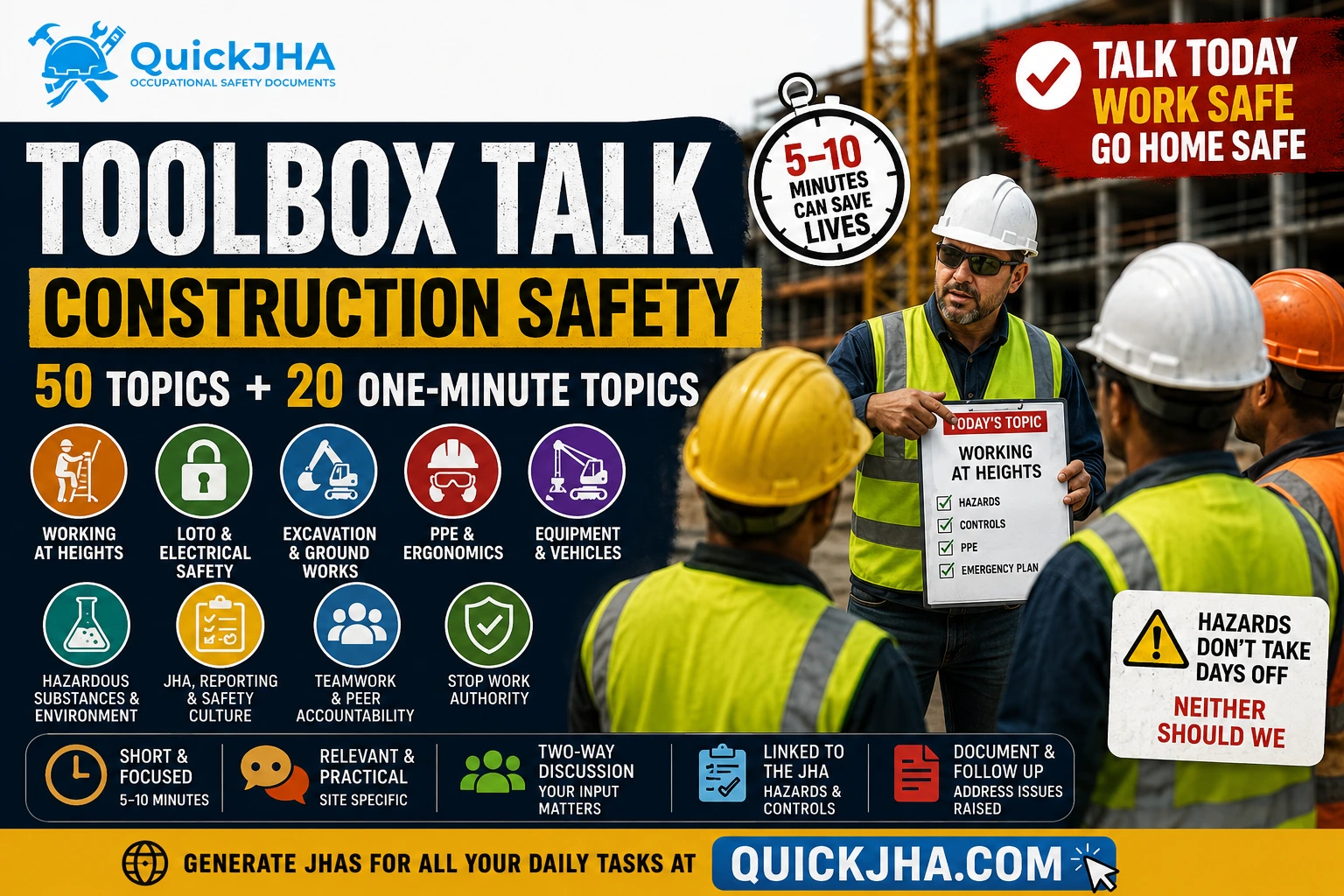
What Is a Toolbox Talk?
A toolbox talk (also called a safety briefing, tailgate meeting, or pre-task meeting) is a short, informal safety discussion held at the work site typically at the start of a shift or before a specific high-risk task begins. The name comes from the tradition of gathering workers around a toolbox for a brief safety chat.
Toolbox talks are one of the most effective and cost-efficient safety training methods available. They are short (5–15 minutes), practical, focused on current hazards, and delivered by the person who knows the worksite best the supervisor. Regular toolbox talks, linked to the site's JHA programme, create a safety culture where hazard awareness is a daily habit, not a compliance box-tick.
50 Toolbox Talk Topics for Construction Safety
- Working at Heights: Understanding fall protection requirements under OSHA 1926.502
- Personal Fall Arrest Systems: How to inspect, don, and use a safety harness correctly
- Scaffold Safety: Guardrail requirements, working load limits, and safe access
- Ladder Safety: Angle rule, securing ladders, and prohibited uses
- Roof Edge Protection: Guardrails vs warning lines vs safety monitoring systems
- Floor Openings and Holes: Covering and guarding requirements (OSHA 1926.502(b))
- Mast Climber and Man Lift Safety: Safe operating procedures and inspection requirements
- Lockout/Tagout (LOTO) Procedures: Step-by-step LOTO with examples from your worksite
- GFCI Protection: Why and where GFCI protection is required on construction sites
- Arc Flash Awareness: What arc flash is, its dangers, and required PPE categories
- Overhead Power Lines: Minimum clearance distances (OSHA Table V-1) and spotters
- Electrical Cord Inspection: How to identify damaged cords and when to take them out of service
- Temporary Wiring: Requirements for temporary electrical installations on job sites
- Working Near Buried Utilities: Locating utilities, hand digging zones, and emergency response
- Excavation Safety: Soil classification, sloping requirements, and trench box use
- Competent Person for Excavations — Who qualifies and what their daily inspection duties are
- Spoil Pile Management: Safe distance from trench edge and load calculations
- Dewatering and Unstable Soils: Additional hazards and controls for wet or sandy ground
- Working in Proximity to Underground Services: Colour coding, hand digging, and standby procedures
- PPE Selection and Inspection: How to choose, inspect, and replace PPE correctly
- Hard Hat Types and Ratings: Class E vs G vs C and when each is required
- Eye and Face Protection: Safety glasses vs goggles vs face shields: when to use each
- Hard Hat Types and Ratings: Class E vs G vs C and when each is required
- Eye and Face Protection: Safety glasses vs goggles vs face shields: when to use each
- Hearing Conservation: Noise exposure limits, mandatory hearing protection zones
- Respiratory Protection: When to use disposable vs half-face vs full-face respirators
- Manual Handling and Lifting Technique: Correct technique, team lifts, and mechanical aids
- Heat Stress and Dehydration: Symptoms, prevention, and first response to heat illness
- PPE Selection and Inspection: How to choose, inspect, and replace PPE correctly
- Hard Hat Types and Ratings: Class E vs G vs C and when each is required
- Eye and Face Protection: Safety glasses vs goggles vs face shields: when to use each
- Hearing Conservation: Noise exposure limits, mandatory hearing protection zones
- Respiratory Protection: When to use disposable vs half-face vs full-face respirators
- Manual Handling and Lifting Technique: Correct technique, team lifts, and mechanical aids
- Heat Stress and Dehydration: Symptoms, prevention, and first response to heat illness
- Pre-Start Equipment Checks: Why and how to complete a daily machine inspection
- Crane Safety and Exclusion Zones: Load charts, pick and carry, and exclusion zone management
- Forklift Safety: Pedestrian management, speed limits, and load stability
- Reversing Vehicles: Spotter requirements, reversing alarms, and site traffic management
- Elevated Work Platform (EWP) Safety: Pre-start checks, wind speed limits, and ground conditions
- Chainsaw Safety: PPE, refuelling, kickback prevention, and exclusion zones
- Grinding Safety: Guard requirements, wheel inspection, PPE, and restart procedure
- Power Tool Safety: Inspection, guarding, and double-insulated tool requirements
- Silica Dust: Health effects, OSHA Table 1 controls, and respiratory protection requirements
- Asbestos Awareness: How to identify asbestos-containing materials and what to do if disturbed
- Chemical Safety and SDS: How to read a Safety Data Sheet and find emergency information
- Confined Space Entry: Permit requirements, atmospheric testing, and rescue procedures
- Working in Extreme Cold: Frostbite, hypothermia, and cold weather PPE
- Environmental Spill Prevention: Fuel, oil, and chemical containment on site
- Job Hazard Analysis (JHA) Briefing: How to read, understand, and follow a JHA
- Incident Reporting: What to report, how to report it, and why it matters
- Near Miss Reporting: Why near misses are free lessons and how to report them
- Stop Work Authority: Your right and responsibility to stop unsafe work
- Safety Culture and Peer Accountability: Looking out for your workmates
- Fatigue Management: Signs of fatigue, reporting obligations, and fitness for duty
- Mental Health in Construction: Recognising stress and the resources available
- Fire Prevention on Site: Housekeeping, hot work permits, and extinguisher locations
- Emergency Evacuation Procedures: Muster points, warden roles, and headcount
- Drug and Alcohol Policy: Zero tolerance, testing procedures, and support resources
Electrical Safety (Topics 8–14)
Excavation & Ground Works (Topics 15–19)
PPE and Ergonomics (Topics 20–26)
PPE and Ergonomics (Topics 20–26)
Equipment & Vehicles (Topics 27–34)
Hazardous Substances & Environment (Topics 35–40)
Documentation & Culture (Topics 41–50)
20 One-Minute Safety Topics for Busy Sites
When time is short, use these ultra-brief reminders at the start of the shift:
- Check your PPE before you start damaged gear protects no one
- Never work under a suspended load, no matter how briefly
- If you see it, fix it or report it hazards don't go away on their own
- Know your muster point and emergency contacts before you need them
- Three points of contact on every ladder, every time
- Never override a safety guard it's there because someone got hurt without it
- Drink water before you feel thirsty by then you're already dehydrated
- Read the JHA before you pick up a tool
- Reversing vehicles kill stay visible and make eye contact with operators
- A cluttered work area is an accident waiting to happen spend 5 minutes tidying
- Fatigue kills. If you're too tired to work safely, say so
- Silica dust is invisible — use wet methods or LEV dust controls for all cutting
- Never enter a confined space without a valid permit and continuous monitoring
- Stop work if conditions change no schedule is worth your life
- Store all chemicals away from ignition sources and in sealed, labelled containers
- Inspect your harness every single time before you put it on
- Know where the nearest defibrillator and first aid kit are located on this site
- Report near misses the near miss you report today may prevent a fatality tomorrow
- Never assume a circuit is de-energised verify with a tester before touching it
- Your family expects you home tonight work safe
How to Run an Effective Toolbox Talk Meeting
- Keep it short: 5 to 10 minutes maximum. Workers disengage after 10 minutes standing in PPE.
- Make it relevant: Talk about hazards that exist on THIS site TODAY, not generic industry stats.
- Encourage two-way conversation: Ask workers what hazards they have noticed. Their input is invaluable.
- Link it to the JHA: Reference the JHA for the day's tasks. 'Today's main risk is X — here's what the JHA says we must do.'
- Sign-in sheet: Record attendees, date, topic, and any issues raised. This is your proof of training.
- Follow up on action items: If a worker raised a concern, address it and report back at the next talk.
- Rotate topics: Use the 50 topics above to ensure every key hazard is covered at least once per quarter.
OSHA Toolbox Talk Requirements
OSHA does not mandate the term 'toolbox talk' specifically, but several standards require safety meetings and pre-task briefings:
- 29 CFR 1926.21: Construction safety training and education requirements
- 29 CFR 1910.1200 (HazCom): Employees must be trained on chemical hazards, which toolbox talks can deliver
- EM 385-1-1: Requires daily safety meetings or pre-task briefings on USACE projects
- Many client pre-qualification requirements: Clients such as oil majors and tier-1 contractors require evidence of regular toolbox talks and safety meetings as part of contractor management
Linking Toolbox Talks to Your JHA Programme
The most effective toolbox talk programme is directly connected to the JHA system. The process is simple: before any task begins, the supervisor reviews the JHA with the crew. This serves as both the toolbox talk and the pre-task briefing. Workers sign the JHA as evidence they have been briefed. The hazards and controls in the JHA become the talking points. The briefing is documented. This approach satisfies both toolbox talk requirements and JHA programme requirements in a single, efficient step.
Generate JHAs for all your daily tasks at quickjha.com

Recent Posts
JHA, AHA & JSA Compliance Checklist: What Auditors Check
A field-ready compliance checklist for JHAs, AHAs, and JSAs, covering US, Australian, Canadian, UK, New Zealand, and UAE standards, plus what auditors flag. Primary Keyword: checklist for job safety analysis jsa consists of
Sep 22, 2026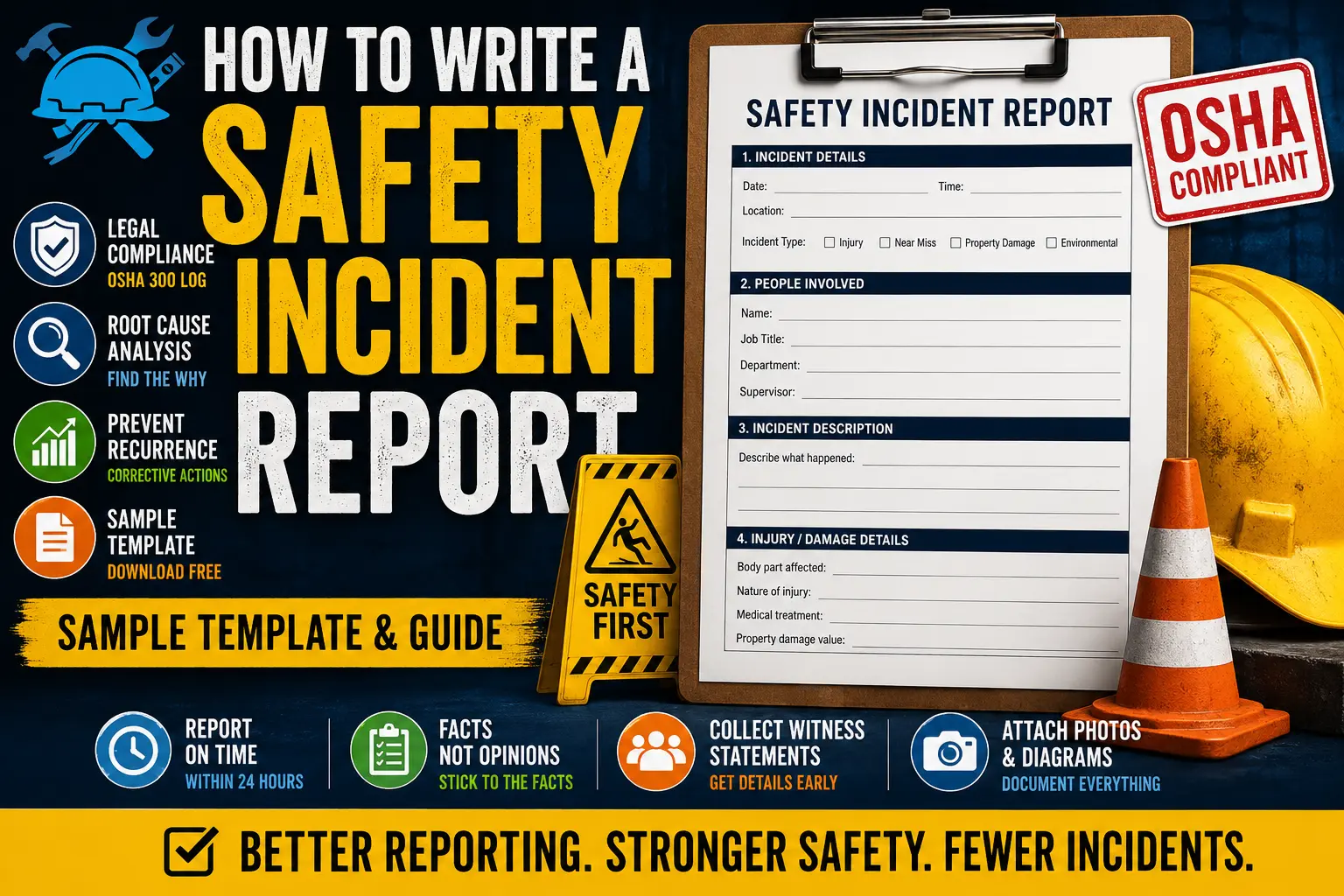
How to Write an Incident Report + Free Sample Template
A step-by-step guide to writing a safety incident report that meets OSHA recordkeeping requirements includes a free sample template, common mistakes to avoid, and how JHAs help prevent future incidents.
Jul 03, 2026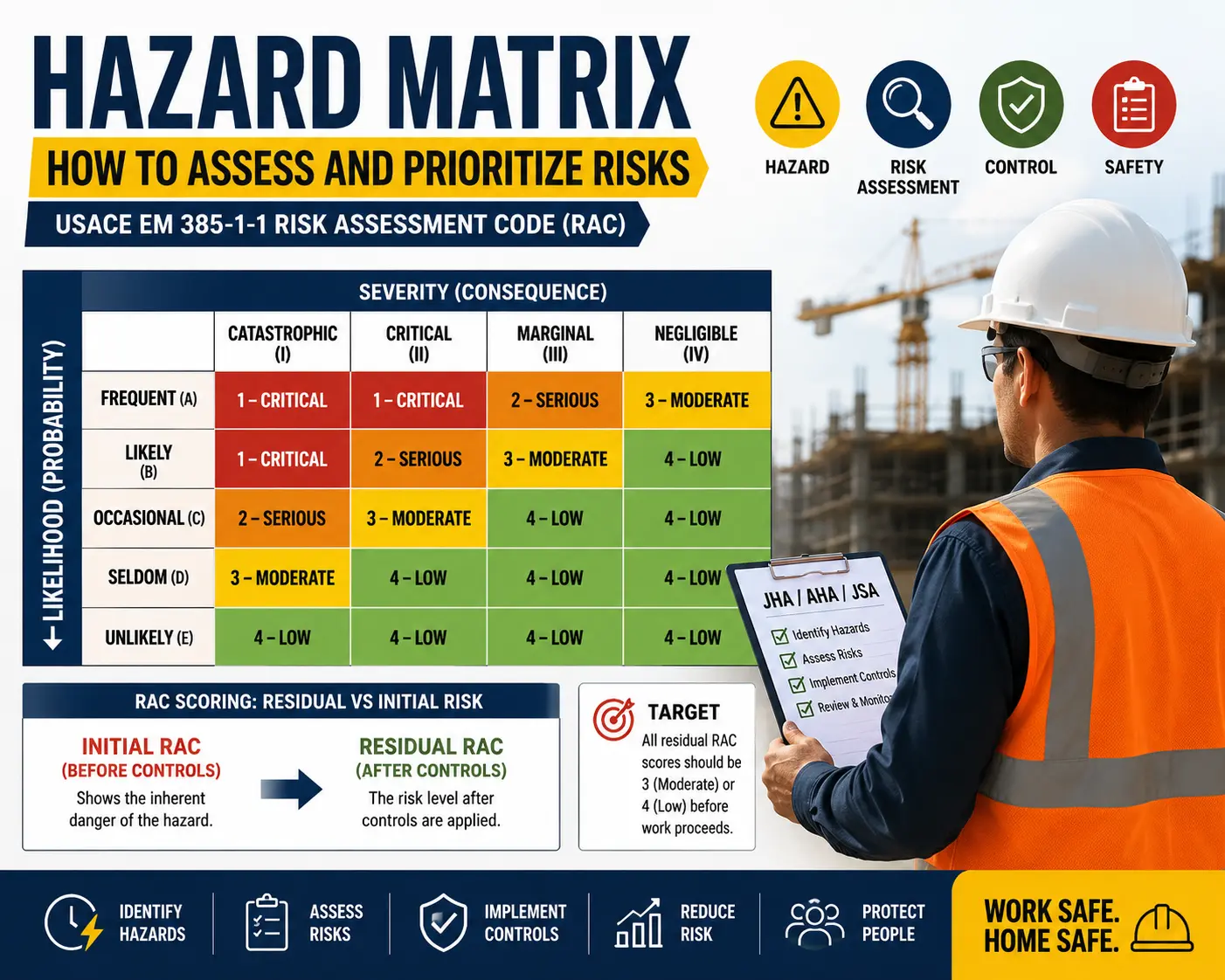
Hazard Matrix: How to Use a Risk Assessment Matrix in Safety
Understand how a hazard matrix works, how to read likelihood × severity risk ratings, what RAC scores mean, and how to apply a risk assessment matrix correctly inside JHA and AHA documents.
Jun 30, 2026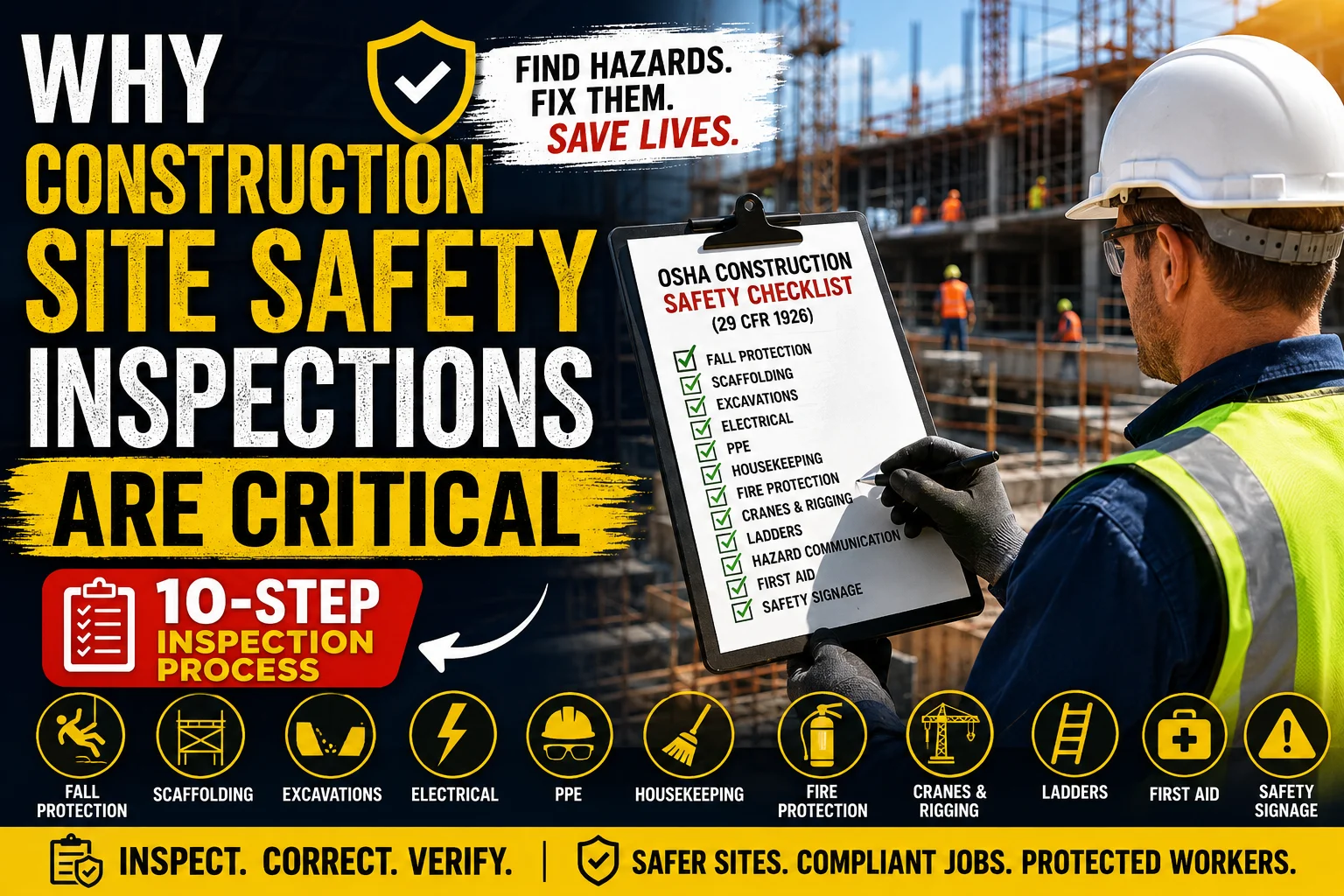
How to Inspect a Construction Site for Safety: 10-Step Guide
A complete guide to construction site safety inspections including an OSHA 29 CFR 1926 checklist, a 10-step inspection process, common violations, and how JHA documentation supports pre-inspection planning.
Jun 25, 2026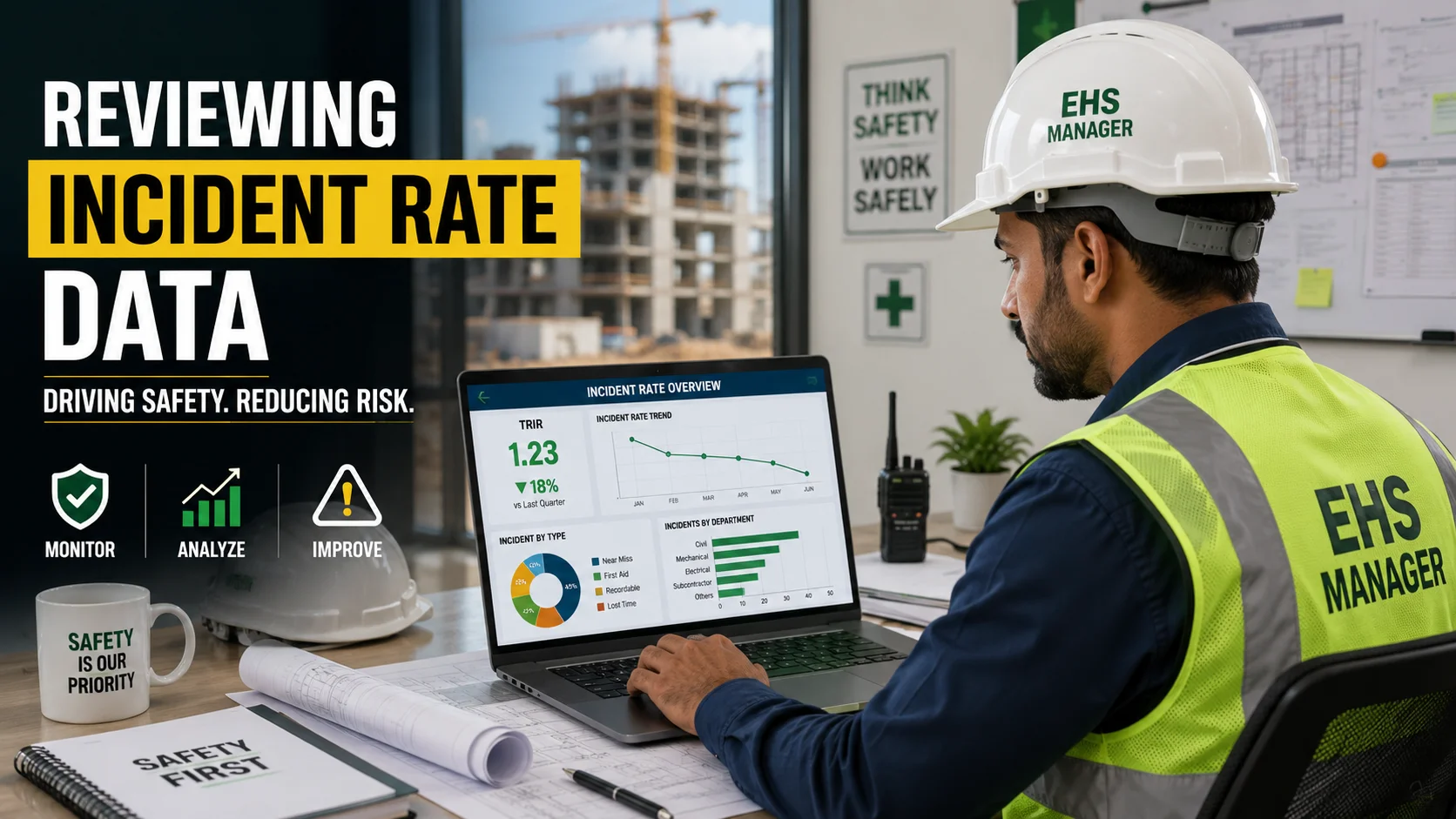
How to Calculate TRIR: Step-by-Step Guide with Formula & Examples
Learn what TRIR means, the exact formula for calculating Total Recordable Incident Rate, worked examples, what a good TRIR score looks like, and how JHA documentation helps you reduce it.
Jun 24, 2026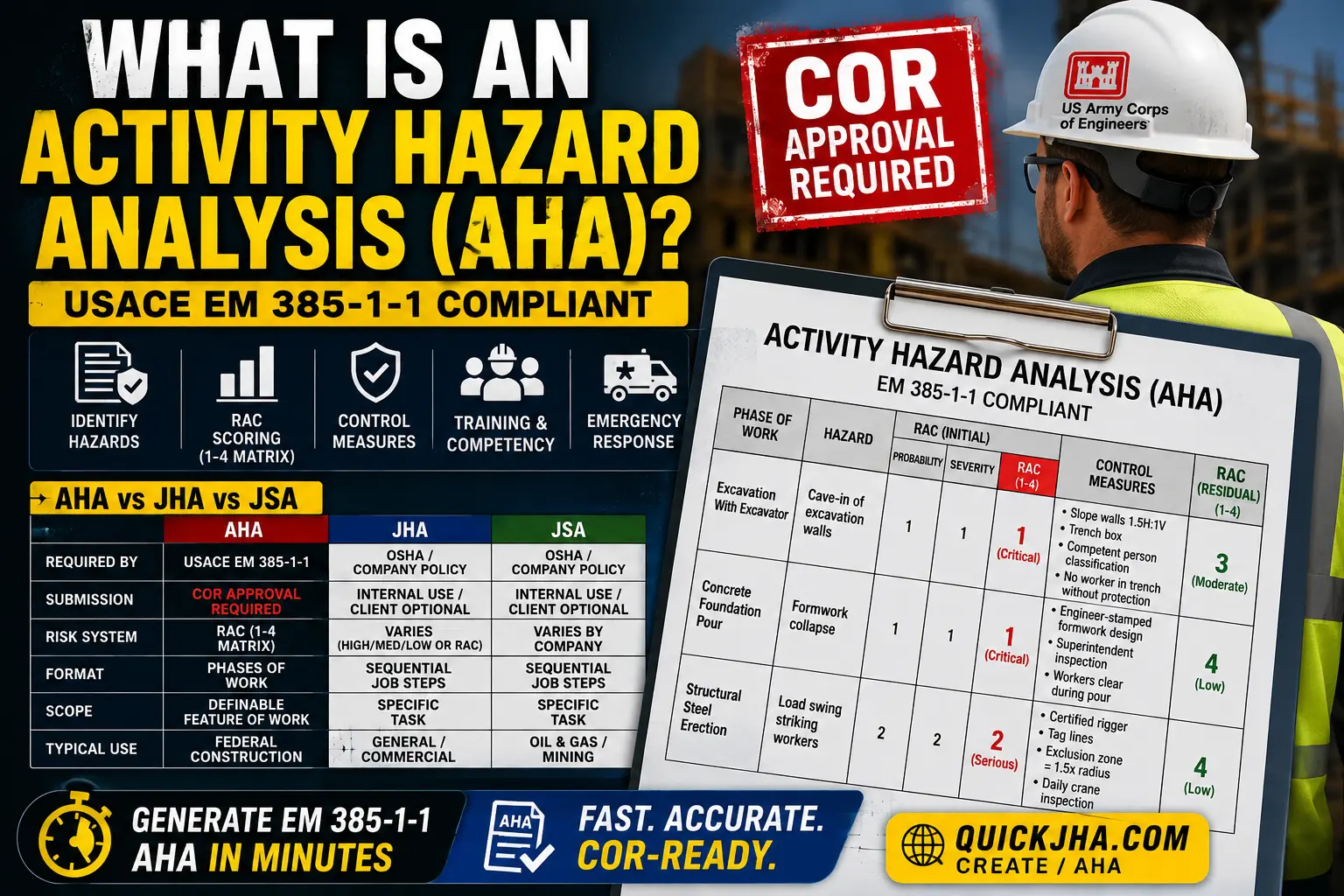
Activity Hazard Analysis (AHA) Guide for EM 385-1-1
The complete guide to Activity Hazard Analysis (AHA) for USACE and federal contractors. Understand EM 385-1-1 requirements, AHA format, real construction examples, and how to generate a compliant AHA in minutes.
Jun 22, 2026Generate Safety Documents in Seconds
Create OSHA-compliant JHAs, AHAs, and JSAs instantly. Professional formatting, zero effort, built for safety professionals.